

Key Products
Glass Cleaner from Iran: Bulk, Concentrate and Private Label Window Cleaning Liquid
Why Source Glass Cleaner from Iran?
Iran has a large, genuinely mature home-care and detergent manufacturing industry. It is not a cottage sector: there are high-volume filling plants running automatic lines for surface cleaners, dishwashing liquids, laundry products and disinfectants, serving a domestic market of close to ninety million people. That base means real filling capacity, in-house formulation chemists, and OEM and private-label work as a normal part of the business rather than a favour.
For a foreign buyer, the sourcing case is competitive raw-material and labour costs, flexibility on formulation and pack format, and short overland freight to Iraq, Afghanistan, Central Asia and the Caucasus – markets where Iranian home-care products already have distribution and brand familiarity.
There is one commercial reality that has to be said before anything else, because it determines whether this product makes sense for you at all: ready-to-use glass cleaner is about 90-95% water. Shipping a container of it across an ocean means paying ocean freight to move water. For a buyer in a neighbouring country with truck freight, that is fine. For a buyer in Northern Europe or West Africa, the honest answer is usually buy the concentrate and dilute locally, or buy the formula and have it filled near your market – and we will tell you that rather than sell you a container of water. See the pack format section below; it is the most important commercial decision on this page.
Product Overview & Use Cases
Glass cleaner is a water-based surface cleaner built around a fast-evaporating solvent system that lifts grease and dries without leaving a film. The Iranian industry produces it in several distinct commercial forms:
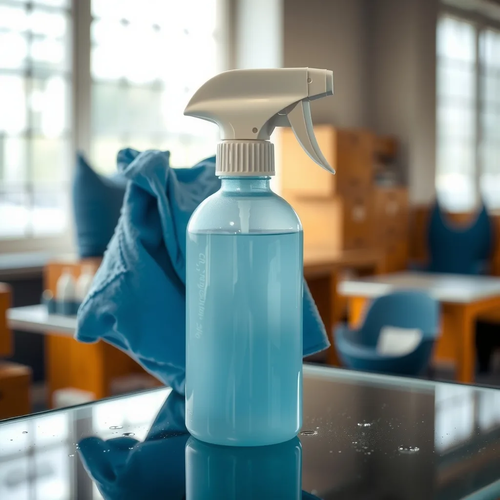
- Ready-to-use (RTU) trigger spray – the retail standard, typically 500 ml to 1 litre in an HDPE or PET bottle with a trigger sprayer.
- RTU refill bottles and jugs – 1-5 litres, flat cap, for refilling trigger bottles. Cheaper per litre and increasingly the retail growth format.
- Bulk RTU – 20 litre jerrycans and 200 litre drums for contract cleaning companies and facility management.
- Concentrate – typically 1:10 to 1:40 dilution, sold in 5-20 litre containers. The format that actually travels economically.
- Ammonia-free formulations – for markets or channels where the ammonia odour is unacceptable, or where the product is used near food preparation.
- Automotive glass cleaner and windscreen washer fluid – adjacent products from the same lines, including winter grades with antifreeze (methanol or ethanol based) which carry very different transport and labelling requirements.
End users: retail chains and discounters buying private label, janitorial and facility-management distributors, hotel and hospital supply, automotive aftermarket, and industrial buyers cleaning display cases, panels and windows.
Since the bottle is often a larger share of the landed cost than the liquid, buyers frequently source both together – see our guide to plastic bottles from Iran.
Formulation: What You Are Actually Specifying
A supplier who cannot discuss this section in detail is a filler, not a manufacturer. That may be fine – but you should know which you are dealing with.
The solvent system does the work and determines the streak behaviour:
- Isopropanol (IPA) or ethanol, typically a few percent, as the fast-evaporating component. Ethanol is common in Iran given domestic availability; IPA gives a slightly different dry-down.
- Glycol ether – usually butyl glycol ether (EGBE / 2-butoxyethanol), a slower-evaporating solvent that cuts grease and film. This is the ingredient that makes the difference between a cleaner that handles a greasy kitchen window and one that only handles dust.
- The ratio between fast and slow solvent is what controls streaking. Too fast and the product dries before it is wiped; too slow and it leaves a film.
Surfactant – a small amount of non-ionic surfactant for wetting and soil release. Overdosing surfactant is the commonest cause of streaking in a cheap formulation, and it is a tempting place to cut cost because it makes the product foam attractively in the bottle.
Alkalinity – ammonia is the traditional choice and is genuinely effective; ammonia-free alternatives use other alkalis or run closer to neutral. State which you want. Ammonia affects odour, labelling and acceptability in food-adjacent settings.
Water quality – deionised or softened water, not tap water. Hard water leaves mineral film on drying and will make an otherwise good formula streak. Ask directly what water the plant uses; it is a cheap question that reveals a lot.
Dye and fragrance – cosmetic, but dye choice affects stability in sunlight on a retail shelf, and fragrance is a frequent allergen-labelling trigger in the EU.
Performance you should test rather than accept: streak-free dry-down on real glass, grease removal, foam level, freeze-thaw stability, colour stability under light, and compatibility with the specific bottle and sprayer.
Regulatory Compliance – Resolve This Before You Order
This is where importers of cleaning chemicals actually get stopped, and it is more demanding than most first-time buyers expect.
- Safety Data Sheet (SDS) in GHS format, in the destination language, prepared to the destination’s regulation – for the EU, REACH Annex II format. An SDS written for the Iranian market will not do.
- CLP classification and labelling for the EU/UK: hazard pictograms, signal word, H- and P-statements. Glass cleaner is often classified as an eye irritant, and alcohol content can affect flammability classification.
- UFI code and Poison Centre notification under CLP Annex VIII – mandatory for hazardous mixtures placed on the EU market. The UFI must appear on the label. This is a real, enforced obligation and it is the single most common thing a first-time importer has not budgeted for.
- EU Detergents Regulation (EC) 648/2004 – ingredient listing rules, the ingredient data sheet requirement, and surfactant biodegradability.
- Transport classification. Alcohol content determines flash point. A formula above the threshold becomes a dangerous good (UN 1993, flammable liquid), which changes freight cost, documentation, packing and whether it can go by air at all. Ask for the measured flash point, not an estimate. Windscreen washer fluid with methanol is almost always a dangerous good.
- Destination-specific registration – many markets require product notification or registration before first import. The Gulf states, Turkey, Russia (EAEU) and most of Africa each have their own regime.
- Halal certification where required – relevant given ethanol content, and available in Iran.
- Eco-labels (EU Ecolabel and similar) if you are targeting that channel – these constrain the formulation significantly and must be designed in from the start.
Sanctions and banking. Chemicals attract more scrutiny than most categories. Before you commit, the payment route and the import path for your specific jurisdiction need to be established. We will give you a straight assessment of what is and is not workable for your situation rather than promise a channel that does not exist.
Packaging, Pack Format & Marking
The pack format decision drives the economics of the whole order.
| Format | Freight efficiency | Best for |
|---|---|---|
| RTU trigger spray | Poor – mostly water and air | Neighbouring markets, retail-ready |
| RTU refill jug | Moderate | Regional retail, lower cost per litre |
| Bulk drum / IBC | Moderate | Contract cleaning, local re-filling |
| Concentrate | Excellent | Distant markets, lowest landed cost per use |
The trigger sprayer is the component most likely to fail, and most likely to be under-specified. It is a precision plastic assembly, frequently imported into Iran rather than made there, which means it can also be the item that drives your lead time. Specify the output per stroke, the spray pattern (mist versus stream, or an adjustable nozzle), the dip-tube length, and require a cycle test – a few thousand actuations without leaking or losing prime. A returned bottle is almost never a liquid failure; it is a sprayer failure.
Also specify:
- Bottle material and weight – HDPE or PET, wall thickness, and neck finish matched to the sprayer
- Chemical compatibility between the formula and the bottle over time, verified by accelerated ageing, not assumed
- Induction seal or tamper evidence where the market expects it
- Label material and adhesive – must survive the product itself being sprayed on it, plus humidity in transit
- Label content: CLP elements, UFI, ingredient declaration, net volume, batch code, best-before or production date, importer details as the destination requires
- Fill accuracy and a declared tolerance
- Carton, shrink-wrap and pallet configuration, with pallets sized to your destination’s standard
MOQ, Lead Time & Incoterms
MOQ is usually driven by the label print run and the sprayer order rather than by the liquid. Expect a realistic minimum in the region of a few thousand units per SKU for private label, lower for a plain or generic label, and lower still for bulk and concentrate where there is no retail packaging to commit to. If you are testing a market, start with bulk or a generic label – it moves the minimum down substantially.
Lead time typically runs 4-8 weeks for a private-label RTU order: formulation approval and stability testing, artwork and plate production, sprayer and bottle procurement, then filling. Filling itself is fast; everything before it is not. Add time for a first order that needs SDS authoring, CLP classification and UFI registration – that is a documentation project running in parallel, and it should start on day one, not after production.
Incoterms: FOB Bandar Abbas for sea freight; EXW is common and economically sensible for overland movement to Iraq, Afghanistan, Turkey, Armenia, Azerbaijan and Central Asia. CFR/CIF is available. Confirm early whether your formula is a dangerous good – it changes the freight quotation, the documentation and sometimes the carrier.
Price & Total Cost of Ownership
Glass cleaner unit economics are unusual: the packaging routinely costs more than the contents. A trigger sprayer, bottle, label and carton can easily exceed the value of the liquid inside. Implications:
- Compare on cost per litre of use-dilution, not cost per bottle. A concentrate at a high per-litre price is usually far cheaper in use.
- Freight is a first-order cost, not a rounding error. Run the landed-cost calculation before you fall in love with the ex-works price.
- Solvent content is the main liquid cost driver. A cheaper quote usually means less glycol ether, and that shows up as poor grease performance the first time a customer cleans a kitchen window.
- Sprayer quality is the second. It is invisible in a quotation and extremely visible in a return rate.
- Compliance costs are real and mostly one-off – SDS authoring, CLP classification, UFI registration, destination notification. Budget them at the start; they do not scale with volume, so they hurt most on a small first order.
The TCO framing: a cleaner that streaks or a sprayer that fails does not generate a warranty claim, it generates a delisting. In private label the retailer’s judgement is binary and rarely revisited. Pay for the formulation testing and the sprayer cycle test.
How IranLocalize Reduces Your Risk
- Plant verification. We visit the facility, confirm it formulates and fills rather than sub-contracting both, and check that the water treatment, QC lab and batch records actually exist.
- Formulation specification. We turn your requirement into a written spec: solvent system and percentages, surfactant type, alkalinity, pH range, density, flash point, appearance and odour.
- Sample and performance testing. Streak, grease removal, foam, freeze-thaw, light stability, and compatibility with the exact bottle and sprayer you will use.
- Sprayer cycle testing – the test nobody runs and everybody needs.
- Regulatory coordination. We work with your compliance provider on SDS, CLP classification, UFI and destination notification – and we flag early where a formula will cause a problem, so it can be reformulated rather than rejected.
- Contracting with hard specs, batch retention requirements, inspection rights and penalties.
- Pre-shipment inspection – fill level, label accuracy including UFI and batch code, carton and pallet condition, retained samples.
- Straight answers on freight. If shipping RTU to your market makes no economic sense, we will say so and price the concentrate instead.
RFQ Checklist – Send This to Get a Precise Quote
- Pack format – trigger spray, refill jug, drum, or concentrate (and dilution ratio).
- Volume per unit and quantity per SKU.
- Destination country – this determines the entire compliance package.
- Ammonia or ammonia-free.
- Performance target – general household, or heavy-duty/greasy commercial soil.
- Colour and fragrance, or unscented and uncoloured.
- Private label or generic – and who supplies the artwork.
- Bottle material, weight and neck finish; sprayer type and spray pattern.
- Any eco-label, Halal or other certification required.
- Whether you have an existing formula to match, or a benchmark product to beat.
- Shelf-life requirement and the climate it will be stored in.
- Incoterm, destination port or border crossing, and target shipment window.
- Who is authoring the SDS and handling CLP/UFI – you, us, or a third party.
Buyer Mistakes and How to Avoid Them
- Shipping water across an ocean. Fix: run the concentrate maths before committing to RTU. For distant markets it is rarely close.
- Discovering the UFI and Poison Centre obligation after production. The labels are already printed. Fix: start the compliance workstream on day one.
- Under-specifying the trigger sprayer. Fix: specify output, pattern and dip tube, and require a cycle test.
- Buying on price per bottle. Fix: compare cost per litre of use-dilution, landed.
- Accepting a cheaper formula without testing grease removal. The cut is almost always glycol ether. Fix: benchmark against your reference product on greasy glass, not clean glass.
- Ignoring flash point until the freight forwarder asks. Fix: get it measured early; it may change your formula, your packaging and your route.
- Assuming the plant uses treated water. Fix: ask. Hard water will streak a good formula.
- Not testing bottle and formula compatibility over time. Panelling, stress cracking and label lift appear at month four, not week one. Fix: accelerated ageing before the first full order.
- Skipping pre-shipment inspection on label accuracy. A missing UFI or wrong batch code makes a compliant product unsellable.
FAQs
Should I import ready-to-use or concentrate? If you are in a neighbouring country with truck freight, RTU is usually fine and gets you retail-ready product. If you are further away, concentrate is almost always the better economics – often dramatically so. Run the landed cost per litre of use-dilution; the answer is rarely ambiguous.
Can Iranian manufacturers match my existing formula? Usually yes. Send the SDS and a physical sample of the benchmark product. Matching performance is realistic; matching an exact proprietary composition is not, and any supplier claiming otherwise is overselling.
What is a UFI and do I really need one? A Unique Formula Identifier, required on the label for hazardous mixtures placed on the EU market under CLP Annex VIII, linked to a Poison Centre notification. If you are importing into the EU, yes, and it is enforced. It must be arranged before labels are printed.
Is glass cleaner a dangerous good for shipping? It depends on the flash point, which depends on alcohol content. Many RTU household formulas are not; higher-alcohol and automotive/winter formulas often are. Get the flash point measured and stated on the SDS before booking freight.
Can I get ammonia-free? Yes, and it is a routine request. It affects odour and slightly changes cleaning performance on heavy grease, so benchmark it rather than assuming equivalence.
What is a realistic first order? For a market test, a bulk or generic-label order in the low thousands of litres. For private label retail, a few thousand units per SKU, with the compliance work started well before production.
Can you supply the bottles too? Yes – Iran has a substantial plastic packaging industry, and sourcing bottles and liquid together often improves both cost and coordination. See our guide to plastic bottles from Iran.
Collaboration Workflow with IranLocalize
- Send your RFQ using the checklist above, with a benchmark sample if you have one.
- We shortlist verified manufacturers and return technical and commercial proposals, stating clearly who formulates and who only fills.
- Formulation and sample approval – lab samples, then a pilot batch, tested on your soils and your glass.
- Packaging approval – bottle, sprayer and label, with compatibility and cycle testing.
- Compliance package – SDS, CLP classification, UFI and destination notification, in parallel with the above.
- Contract with hard specs, batch retention, inspection rights, penalties and milestones.
- Production and pre-shipment inspection with photographic evidence and retained samples.
- Shipping and documentation, with dangerous-goods handling where applicable.
- Post-launch review – return rates and customer feedback feed back into the next batch’s specification.
Executive Summary
- Why Iran: a large, mature home-care manufacturing base with real filling capacity and routine OEM/private-label experience, competitive costs, and strong overland freight to regional markets.
- What actually matters: the pack format decision (RTU versus concentrate), the solvent system behind streak-free performance, the trigger sprayer, and the EU compliance package – SDS, CLP, UFI.
- Where buyers lose money: paying ocean freight to move water, and discovering the UFI obligation after the labels are printed.
- Why IranLocalize: we verify whether your supplier formulates or only fills, specify the formula in numbers, test the product and the sprayer, coordinate the compliance work, and tell you honestly when the freight maths does not work.
Ready to evaluate glass cleaner manufacturers in Iran? Send us your destination market, pack format and target performance – or just a sample of what you buy today. We will come back with verified options, tested samples, and a realistic compliance timeline.