

Key Products
Machine-Made Carpets from Iran
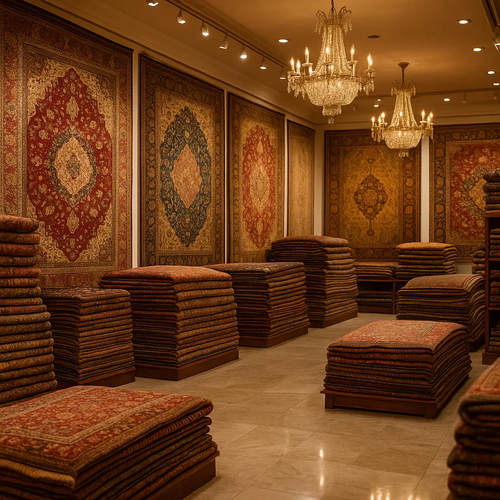
Why Source Machine-Made Carpets from Iran?
Kashan is the recognized global capital of machine-made carpet production, home to well over a thousand factories running modern European weaving lines. That concentration gives Iran a depth of capability — reed density, yarn technology, finishing — that few other origins can match at comparable price points. For B2B buyers (importers, flooring retailers, hospitality/contract furnishers, private-label brands), sourcing directly from an Iranian factory means access to the full range of grades and custom options, rather than whatever a single reseller happens to stock.
If you’re comparing origins purely on landed unit price, you can find cheaper options elsewhere. If you care about pattern sharpness, density consistency, and OEM flexibility at scale, Iranian manufacturers built around Kashan’s cluster of yarn spinners, dyers, and weavers are hard to match. IranLocalize exists to make that access safe and simple for a foreign buyer: verified factories, clear specs, enforceable contracts, and shipment-level QC — so you get the benefit of Iran’s manufacturing depth without having to navigate it yourself.
Product Overview & Use Cases
Machine-made carpets are power-loomed floor coverings woven on computer-controlled looms, offering the look of hand-knotted rugs at production speeds and price points hand-weaving can’t match. Common buyer segments:
- Furniture and flooring retail chains
- Hospitality (hotels, banquet halls) and contract/commercial fit-outs
- E-commerce and private-label home goods brands
- Regional wholesalers/distributors re-selling into their own domestic market
Reed Count & Density: The Core Spec
Iranian machine-made carpets are graded primarily by reed count — the number of knots woven across one meter of width — paired with density (total knots per square meter). Higher reed/density means finer pattern definition and a flatter, more detailed weave; lower reed count gives a thicker, softer pile.
Common grades:
- 700 reed (density ~2100-3000, typically 2550): Thicker pile, softer underfoot, most price-competitive — a practical entry grade for volume/budget-driven orders.
- 1000-1200 reed (density up to ~3600): The most common mid-to-premium grade for retail and hospitality use — sharper pattern than 700 reed at a moderate price step up.
- 1500 reed (ultra-high density): The finest commercially produced grade, achieved with premium heat-set acrylic yarn — closest visual match to hand-knotted detail, at a corresponding price premium.
Non-negotiable truth (buyer’s perspective): a supplier quoting “1200 reed” without a stated density figure is leaving room to under-deliver on knot count. Always request the density number alongside the reed count, and verify it against a physical sample — not just a spec sheet.
Materials & Construction
- Pile yarn: Heat-set polypropylene (PP) is the standard for volume/value grades; acrylic (often heat-set) is used for higher grades needing a wool-like hand-feel and better colorfastness; viscose/silk-look yarns appear in premium decorative lines.
- Backing: Woven polypropylene or cotton backing with latex coating for dimensional stability — ask for backing weight and latex coverage on technical spec sheets for commercial/contract orders.
- Pile height & construction: Ranges from low-pile flatweave-style looks to plush cut-pile; construction affects both hand-feel and durability under foot traffic.
Quality, Compliance & Testing
- Density verification: Physical knot-count check against the quoted reed/density figure, not just a supplier’s data sheet.
- Colorfastness: Rub and light-fastness testing, especially for acrylic/wool-look yarns intended for direct sun exposure or heavy commercial traffic.
- Dimensional accuracy: Size tolerance checks — machine-made rolls can vary slightly batch to batch.
- Flammability/commercial-use certification: Relevant for hospitality and contract buyers — confirm which standard your destination market requires (e.g. fire-retardancy certificates) before finalizing a spec.
- Sampling (AQL): IranLocalize defines and enforces a sampling plan for every shipment rather than relying on a pre-production sample alone.
Packaging & Marking
- Roll packaging: Standard rolls wrapped in protective film/poly, corner-protected for container loading.
- OEM/private label: Custom edge/border designs, woven or printed labels, custom carton/roll tags, barcode/QR on packaging.
- Carton marks: Design code, size, reed/density, color, roll count, NW/GW, batch/lot, Made in Iran.
MOQ, Lead Time & Incoterms
- MOQ: Varies widely by supplier — from small trial orders (a few square meters/pieces) up to full container loads; larger factories typically want container-scale volume for custom OEM designs, while stock designs can move at lower MOQs.
- Lead time: Stock designs ship fastest; custom colorways/patterns and private-label branding add production time for setup, sampling, and approval.
- Incoterms: EXW/FOB Bandar Abbas most common; CIF/CPT to destination port negotiable case-by-case.
- Payments: Wire transfer (T/T) standard; L/C available case-by-case for larger orders.
Coaching, not comfort: a quote that looks unusually cheap for a stated reed/density almost always means a thinner backing, lower-grade yarn, or an inflated density claim. We verify real specs against physical samples before you commit.
Price & TCO vs. Other Origins
- Where Iran wins: reed/density range and pattern-detail capability at that price point, especially at 1000+ reed — few other manufacturing hubs offer that combination at comparable cost.
- Real cost comparison: freight to your destination market plus consistent QC often yields a lower total cost of ownership than a nominally cheaper origin with higher defect/return rates.
- OEM agility: custom border/pattern changeovers and private-label packaging are practical even at moderate order volumes.
- Supply risk: verified factories plus shipment-level inspection remove the biggest source of landed-cost surprises — density shortfalls, backing defects, colorfastness failures.
How IranLocalize Reduces Your Risk
IranLocalize operates as your sourcing, verification, and QC arm on the ground in Iran:
- Factory screening: production capacity, loom type/reed range, export track record, compliance history.
- Pre-order sampling: physical samples from current production, density-verified against spec — not lab one-offs.
- Negotiation & contracting: hard specs (reed, density, yarn type, backing), Incoterms, penalties, and delivery milestones in writing.
- In-process & pre-shipment inspection (PSI): production monitoring, roll count/weight checks, random unroll inspection, colorfastness spot checks.
- Logistics & documentation: export docs, container loading oversight, destination-market labeling requirements.
- Single point of contact: one project manager on WhatsApp/email for updates and approvals throughout.
RFQ Checklist (Send This to Get a Precise Quote)
- Reed count & density: target grade (700 / 1000-1200 / 1500) and required density figure
- Material: PP / heat-set acrylic / viscose-silk look
- Design: stock catalog design, or custom pattern/colorway (attach reference if custom)
- Sizes: rug sizes or broadloom roll widths needed
- Backing: required backing type/weight for your market
- Quantity: total area/pieces + reorder cadence (one-off / recurring)
- OEM needs: private label, custom border, custom packaging (Y/N)
- Certifications: any flammability/commercial-use certificate required in your destination market
- Destination + Incoterms: FOB/CIF with city/port for freight calculation
- Target lead time: project date or seasonal window
Buyer Mistakes (and How to Avoid Them)
- “Reed count without density.” Result: a supplier quotes a high reed number but under-delivers on actual knot density. Fix: always request and verify the density figure, not reed count alone.
- “No physical sample before ordering.” Result: color, hand-feel, or pattern doesn’t match what was pictured. Fix: approve a current-production physical sample, not a catalog photo, before committing to a full order.
- “Vague backing/material spec.” Result: inconsistent durability or dimensional stability across batches. Fix: written spec sheet covering yarn type, backing weight, and latex coverage.
- “Assuming one factory covers every grade.” Result: forcing a factory specialized in one reed range to produce outside its comfort zone, risking quality drift. Fix: match the factory’s actual specialization to your target grade during screening.
FAQs
What’s the difference between 700, 1200, and 1500 reed carpets? Reed count measures knots per meter of width — higher reed and matching density means finer, sharper pattern detail and a flatter weave; lower reed (700) gives a thicker, softer pile. Density (knots per square meter) must be checked alongside reed count, not assumed from it.
Are Iranian machine-made carpets the same as Persian hand-knotted rugs? No — machine-made carpets are power-loomed for speed and price efficiency; hand-knotted Persian rugs are a separate, much higher-priced category. This page covers machine-made only.
Can we get custom colors or patterns? Yes — most factories offer custom colorways and patterns for OEM/private-label orders, typically at higher MOQs and longer lead times than stock designs.
What backing should we specify for commercial/contract use? Heavier woven backing with full latex coverage for durability under foot traffic; confirm with us based on your specific installation environment (residential vs. high-traffic commercial).
Do we need fire-retardancy certification? Depends on your destination market and end use (hospitality/contract projects often require it). Tell us your market and we’ll confirm what certification the factory needs to provide.
Can orders recur on a schedule? Yes — we can set up a reorder cadence and safety stock once the first order and QC process are validated.
Collaboration Workflow with IranLocalize
- Send RFQ using the checklist above.
- Factory shortlist (2-3 verified options matched to your target grade) with technical/commercial proposals.
- Sample approval — physical, density-verified samples from current production.
- Contract — hard specs, Incoterms, penalties, and delivery milestones in writing.
- Production & PSI — monitored production with photo/video evidence and signed inspection checklists.
- Shipping & documents — aligned to your destination market’s import requirements.
- After-sales — performance review and reorder planning for recurring volume.
Executive Summary
- Why Iran: Kashan’s unmatched manufacturing depth across reed/density grades, mature OEM capability, and competitive FOB pricing.
- What matters: verified density (not just reed count), physical sample approval, and enforceable specs — not catalog photos or price alone.
- Why IranLocalize: unbiased factory verification, precise technical specs, a negotiator on your side, and rigorous pre-shipment inspection.
Ready to evaluate machine-made carpet suppliers in Iran? Share your RFQ. We’ll deliver verified factory options, physical samples, and firm timelines.