

Key Products
Bricks from Iran
Why Source Bricks from Iran?
Iran runs a large, well-established brick manufacturing sector, with modern kiln facilities producing fired clay brick at real industrial scale – some Iranian factories run production capacity in the hundreds of thousands of pieces per day. That scale, combined with access to good-quality natural clay deposits, gives Iran a strong cost and volume position for construction-material buyers across the Middle East, the Caucasus, and Central Asia – markets Iran already exports to at meaningful volume.
If you’re comparing origins purely on a per-piece price, you’ll find competing quotes from several regions. If you need consistent firing quality, dimensional accuracy at scale, and a supplier who can actually produce refractory/firebrick grades alongside standard construction brick, Iran’s combination of raw material access and kiln capacity is hard to match at comparable cost. IranLocalize exists to make that sourcing straightforward for a foreign buyer: verified factories, clear specs by brick category, enforceable contracts, and shipment-level QC.
Product Overview & Use Cases
Iranian brick manufacturing spans several distinct product categories, each with a different buyer base:
- Fired clay/solid brick – general construction, load-bearing walls
- Hollow/perforated brick – lighter weight, better thermal insulation, common in modern wall construction
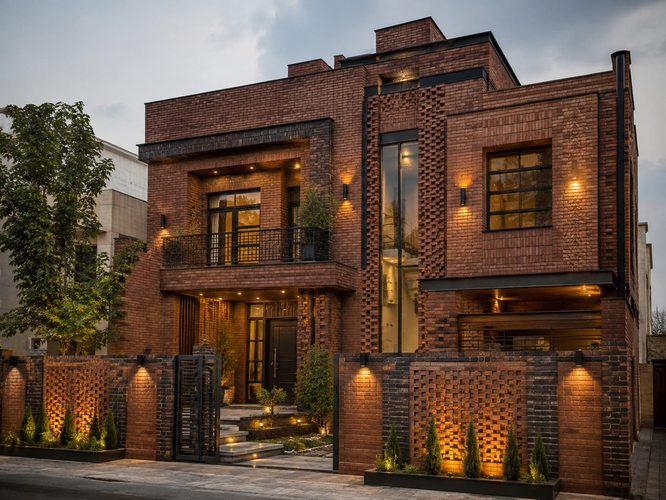
- Facing/facade brick – decorative exterior cladding where appearance matters alongside strength
- Refractory brick (firebrick) – industrial furnace, kiln, and high-temperature lining applications (steel, cement, glass industries)
Buyer’s-perspective note: these categories are not interchangeable, and not every factory that makes construction brick also makes refractory-grade firebrick – confirm which category you actually need before shortlisting suppliers, since the raw material, firing process, and QC standard differ substantially between them.
Types & Specifications
- Hollow brick: classified by structural properties (net cross-sectional area under a defined threshold of gross area) into different types by strength/use case – confirm the specific classification your project’s building code requires.
- Facing brick: valued for a combination of surface finish, color consistency, and weather resistance – color and texture uniformity across a full order is a key QC point, not just individual-piece quality.
- Refractory/firebrick: fireclay-based refractory brick typically runs 30-45% alumina content, giving a refractoriness range of roughly 1,200°C to 1,650°C depending on grade – alumina content is the single most important spec to confirm against your furnace/kiln’s actual operating temperature.
- Compressive strength: construction-grade brick strength is commonly assessed in the 40-80 MPa range depending on grade and intended structural use; refractory brick is evaluated differently, factoring in thermal shock resistance alongside cold crushing strength.
Quality, Compliance & Testing
- Dimensional consistency: size tolerance across a full order – critical for consistent mortar joints and structural predictability at scale.
- Compressive/crushing strength testing: verified against the grade quoted, not assumed from a factory’s general reputation.
- Water absorption: relevant to weathering resistance, particularly for facing brick used in exterior applications.
- Alumina content verification (refractory only): lab-confirmed alumina percentage against the quoted grade, since this directly determines maximum service temperature.
- Sampling: representative sampling from actual production batches – not a single showroom sample – is standard practice IranLocalize enforces on every shipment.
Packaging & Marking
- Palletized/shrink-wrapped: standard for container loading and safe transit, protecting edges and corners from chipping.
- Carton/pallet marks: brick type/grade, dimensions, quantity per pallet, NW/GW, batch/lot, Made in Iran.
- Custom sizing: available from many factories for non-standard project specifications, typically at higher MOQ and longer lead time than standard sizes.
MOQ, Lead Time & Incoterms
- MOQ: varies significantly by factory and brick category – larger construction-brick factories are set up for container-and-truckload volume; refractory brick is often lower-volume, higher-value per shipment.
- Lead time: standard sizes from existing production stock ship fastest; custom dimensions or colors add production time.
- Incoterms: FOB Bandar Abbas, or overland/rail terms for buyers in neighboring countries (Iraq, Armenia, Azerbaijan, Afghanistan, Turkmenistan) given Iran’s established overland export routes to these markets; CIF/CPT to sea ports negotiable case-by-case.
- Payments: Wire transfer (T/T) standard; L/C available case-by-case for larger orders.
Coaching, not comfort: a refractory brick quote significantly cheaper than the market range for a stated alumina grade is a signal to verify that alumina content independently before committing – it’s the spec most likely to be overstated when price is the only thing being negotiated.
Price & TCO vs. Other Origins
- Where Iran wins: kiln capacity and raw material access give competitive per-unit pricing at real industrial volume, especially valuable for large construction projects and overland-accessible neighboring markets.
- Real cost comparison: freight (sea or overland, depending on your market) plus consistent QC often yields a lower total cost than a nominally cheaper origin with higher breakage/inconsistency rates.
- Supply risk: verified factories plus shipment-level inspection reduce the biggest source of landed-cost surprises in bulk brick trade – dimensional inconsistency and breakage in transit.
How IranLocalize Reduces Your Risk
IranLocalize operates as your sourcing, verification, and QC arm on the ground in Iran:
- Factory screening: production capacity, brick category specialization (construction vs. refractory), export track record, compliance history.
- Pre-order sampling: physical samples from current production batches, verified against your specified grade/dimensions.
- Negotiation & contracting: hard specs (type, dimensions, strength, alumina content where relevant), Incoterms, and delivery milestones in writing.
- In-process & pre-shipment inspection (PSI): dimensional checks, strength verification, packaging/palletizing inspection before loading.
- Logistics & documentation: export docs and container/overland loading oversight aligned to your route (sea or land border).
- Single point of contact: one project manager on WhatsApp/email throughout.
RFQ Checklist (Send This to Get a Precise Quote)
- Brick category: solid/fired clay, hollow/perforated, facing, or refractory
- Dimensions: standard or custom size requirements
- Grade/strength: required compressive strength range for your application
- Alumina content (refractory only): target grade and maximum service temperature needed
- Color/finish (facing brick only): if appearance matters for your project
- Quantity: total volume + one-off or recurring cadence
- Destination + route: sea (FOB/CIF port) or overland/land border, with specific location for freight calculation
- Target lead time: project delivery window
Buyer Mistakes (and How to Avoid Them)
- “Assuming any brick factory makes refractory grade.” Result: a construction-brick supplier attempts a firebrick order outside their real capability, risking quality failure at high temperature. Fix: confirm refractory/firebrick specialization specifically – it’s a different product line, not just a “stronger” version of construction brick.
- “No dimensional tolerance check across the full order.” Result: inconsistent mortar joints and structural issues discovered only during construction. Fix: verify size tolerance on samples from actual production batches, not a single showroom piece.
- “Alumina content taken on faith for refractory brick.” Result: brick fails or degrades faster than expected at actual furnace operating temperature. Fix: independent lab verification of alumina content against the quoted grade before committing to volume.
- “Ignoring the overland export option.” Result: paying for sea freight and port handling when Iran’s overland routes to neighboring markets (Iraq, Caucasus, Central Asia) may be faster and cheaper for buyers in those regions. Fix: ask about overland/rail options if your destination is a neighboring country.
FAQs
What’s the difference between hollow brick and solid fired clay brick? Hollow brick has a reduced net cross-sectional area (lighter weight, better insulation), classified into different structural types by strength; solid fired clay brick is the traditional load-bearing option. Which you need depends on your building code and structural requirements.
Can Iranian factories produce refractory/firebrick, not just construction brick? Yes – Iran has an established refractory brick industry alongside construction brick, but not every factory covers both; we match your RFQ to a factory actually specialized in the category you need.
What alumina content should we look for in firebrick? Depends on your furnace’s operating temperature – fireclay refractory brick commonly runs 30-45% alumina, covering a refractoriness range of roughly 1,200-1,650°C. Tell us your operating temperature and we’ll match the right grade.
Can we get custom brick dimensions or colors? Yes, many factories offer custom sizing and, for facing brick, custom color/finish – typically at a higher MOQ and longer lead time than standard products.
Is overland shipping to neighboring countries an option? Yes – Iran has established overland export routes to Iraq, Armenia, Azerbaijan, Afghanistan, and Turkmenistan, which can be faster and more cost-effective than sea freight for buyers in those markets.
Can orders recur on a schedule for an ongoing construction project? Yes – once the first shipment and QC process are validated, we can set up a reorder cadence matched to your project’s build schedule.
Collaboration Workflow with IranLocalize
- Send RFQ using the checklist above.
- Factory shortlist (2-3 verified options matched to your brick category and volume).
- Sample approval – physical samples from current production, verified against spec.
- Contract – hard specs, Incoterms, and delivery milestones in writing.
- Production & PSI – dimensional and strength verification, packaging inspection before loading.
- Shipping & documents – sea or overland route aligned to your destination market.
- After-sales – reorder planning for recurring project volume.
Executive Summary
- Why Iran: large-scale kiln capacity and clay access covering construction brick through refractory-grade firebrick, with established overland routes into neighboring markets.
- What matters: matching the right factory to your specific brick category (construction vs. refractory), verified dimensional/strength specs – not price alone.
- Why IranLocalize: unbiased factory verification, precise technical specs, a negotiator on your side, and rigorous pre-shipment inspection.
Ready to evaluate brick suppliers in Iran? Share your RFQ. We’ll deliver verified factory options, physical samples, and firm timelines.
Buyers combining brick with other Iranian building materials often source natural stone (travertine, marble, granite) for facades and flooring, or construction wire for rebar tying and reinforcement, alongside brick for structural work – ask us about coordinating multiple materials in one sourcing project.