

Key Products
Construction Wire from Iran
Why Source Construction Wire from Iran?
Construction wire – more precisely, binding/tie wire – is the low-carbon steel wire used to fasten rebar and reinforcement mesh together before concrete is poured, alongside related uses in formwork tying, precast production, and general fabrication. Iran’s steel industry is genuinely large-scale: the country is one of the world’s top-15 crude steel producers, with a domestic supply chain running from iron ore through billet and wire rod to finished drawn wire, concentrated around major producers in Isfahan, Khuzestan, and Khorasan. That upstream depth is what makes Iranian wire drawing mills cost-competitive rather than just cheap – they’re working from domestic wire rod, not imported feedstock.
Established Iranian exporters already move this product into Iraq, Oman, the UAE, Armenia, Azerbaijan, Georgia, Pakistan, and African markets. If you’re comparing origins purely on spot price, several regions compete on this simple, high-volume commodity. If you need consistent wire gauge, verified tensile strength, and a supplier who ships on schedule at container volume, that’s where a verified Iranian mill and disciplined export logistics earn their keep. IranLocalize exists to make that sourcing simple for a foreign buyer: verified mills, clear gauge/coating specs, and shipment-level quality control.
Product Overview & Use Cases
- Rebar tying – the core construction use: fastening reinforcement bar intersections before concrete pour, on-site and in precast production.
- Mesh and cage fabrication – securing reinforcement cages and mesh assemblies during handling and transport.
- General fabrication & packaging – bundling, strapping, and light industrial fastening beyond construction sites.
- Fencing and agricultural use – a secondary market for the same base wire product.
Types & Specifications
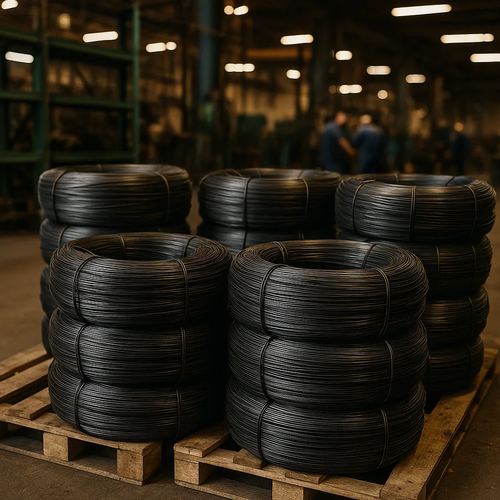
- Black annealed wire: the standard, most economical construction wire – low-carbon steel wire that’s been annealed (heat-treated) for flexibility and ease of hand-tying. This is the default choice for on-site rebar tying.
- Galvanized wire: zinc-coated for corrosion resistance – specified where the wire is exposed to moisture for longer periods, or where a project explicitly requires corrosion-resistant fasteners.
- Gauge/diameter: commonly available from roughly 0.3mm up to 6.0mm, with 18-22 gauge (approximately 0.7-1.2mm) being the most commonly ordered range for standard rebar tying – confirm your required gauge against your specific tying method and rebar size rather than defaulting to a mid-range gauge.
- Format: straight-cut tie wire, coiled wire, and pre-formed loop/U-type ties are all available depending on how your crews actually work with it – coiled wire for hand-tying, pre-formed loops for faster mechanical tying.
Buyer’s-perspective note: “construction wire” as a search term covers a genuinely different product from wire mesh (welded/woven panels) or wire rope (twisted steel cable) – confirm you actually need binding/tie wire specifically before requesting quotes, since a mill specialized in one doesn’t necessarily cover the others well.
Quality, Compliance & Testing
- Tensile strength verification: lab-confirmed against the quoted spec – this is the property that actually determines whether the wire holds under tying tension and handling, not just gauge alone.
- Gauge/diameter consistency: checked across a full coil, not just a sample end – inconsistent diameter is a common quality shortfall in lower-cost wire.
- Coating quality (galvanized only): zinc coating weight and adhesion verified against the quoted corrosion-resistance grade.
- Annealing consistency (black annealed): even, consistent softness across the coil – unevenly annealed wire snaps or work-hardens unpredictably during hand-tying.
Packaging & Marking
- Coil formats: small coils (around 1kg) for retail/site-pack use, larger rolls (around 25kg), and big coils (500kg-1000kg) for bulk industrial/export orders – specify which format matches your handling setup.
- Carton/pallet marks: wire gauge, coating type (black annealed or galvanized), net/gross weight, batch/lot, Made in Iran.
- Private label: custom coil tagging/branding available for distributors reselling under their own brand, typically at a modest cost and lead-time increase over standard bulk packaging.
MOQ, Lead Time & Incoterms
- MOQ: typically starts around 1 metric ton for a trial order, scaling to full container loads for recurring commercial volume – this is a high-volume, price-sensitive commodity, so container-efficient order sizes matter for landed cost.
- Lead time: standard gauges from existing mill stock ship fastest; less common gauges or galvanized coating add production time.
- Incoterms: FOB Bandar Abbas most common for sea freight; overland routes available for buyers in Iraq, the Caucasus, and neighboring markets given Iran’s established export routes there.
- Payments: Wire transfer (T/T) standard for this order size; L/C available case-by-case for larger volume commitments.
Coaching, not comfort: a quote noticeably below the market range for a stated gauge and tensile spec is worth verifying independently before committing – diameter consistency and annealing quality are exactly where cost gets cut when price is negotiated in isolation from spec.
Price & TCO Considerations
- Price scales with gauge, coating, and format: galvanized costs more than black annealed at the same gauge; pre-formed loop ties cost more per kg than plain coiled wire for the labor-saving they provide on site.
- Real cost comparison: landed cost should weigh verified tensile strength and gauge consistency against FOB price alone – wire that snaps or slips during tying costs more in labor and rework than the unit price difference ever saves.
- Supply risk: verified mills with real QC discipline remove the most common source of dispute in bulk wire trade – inconsistent gauge or annealing discovered only once the coil is in use on site.
How IranLocalize Reduces Your Risk
IranLocalize operates as your sourcing, verification, and QC arm on the ground in Iran:
- Mill screening: production capacity, gauge range covered, export track record, coating capability (galvanizing line access).
- Pre-order sampling: physical samples tested for gauge consistency and tensile strength before committing to volume.
- Negotiation & contracting: hard specs (gauge, coating, format, packaging), Incoterms, and delivery terms in writing.
- Pre-shipment inspection (PSI): coil-level gauge checks, weight verification, and packaging inspection before loading.
- Logistics & documentation: export docs and container/overland loading oversight aligned to your route.
- Single point of contact: one project manager on WhatsApp/email throughout.
RFQ Checklist (Send This to Get a Precise Quote)
- Gauge/diameter: target size (commonly 18-22 gauge / ~0.7-1.2mm) or your project’s specific requirement
- Coating: black annealed or galvanized
- Format: coiled wire, straight-cut, or pre-formed loop ties
- Coil/roll size: small coil, 25kg roll, or bulk coil (500kg-1000kg)
- Quantity: trial order (from ~1 tonne) or container-scale recurring volume
- Destination + Incoterms: FOB/CIF with port or border crossing for freight calculation
- Target lead time: delivery window needed
Buyer Mistakes (and How to Avoid Them)
- “Confusing tie wire with wire mesh or wire rope.” Result: requesting quotes from mills that don’t actually specialize in the product you need. Fix: confirm you need binding/tie wire specifically, and shortlist mills accordingly.
- “No tensile strength verification.” Result: wire that snaps under normal tying tension, discovered only on site. Fix: lab-test samples against the quoted tensile spec before committing to volume.
- “Price-only comparison across gauges that aren’t actually equivalent.” Result: a cheaper quote that’s actually a thinner gauge than what your project specified. Fix: compare quotes only after confirming exact gauge/diameter, not just a nominal size label.
- “Ignoring coil format fit for your crew’s actual method.” Result: paying for pre-formed loop ties your crew doesn’t use, or struggling with a coil format that doesn’t suit hand-tying. Fix: match the format to how your team actually works before ordering at volume.
FAQs
What’s the difference between black annealed and galvanized construction wire? Black annealed is heat-treated for flexibility and is the standard, most economical choice for rebar tying; galvanized is zinc-coated for corrosion resistance, specified when the wire will face extended moisture exposure.
What gauge should we order for standard rebar tying? 18-22 gauge (roughly 0.7-1.2mm) covers most standard rebar tying use – tell us your rebar size and tying method and we’ll confirm the right gauge.
Is “construction wire” the same as wire mesh or wire rope? No – these are distinct products. Construction/tie wire is soft wire for hand or mechanical tying; wire mesh is welded or woven panels; wire rope is twisted steel cable. Confirm which you actually need before requesting quotes.
What coil sizes are available? From small ~1kg coils for site-pack use up to 25kg rolls and bulk 500-1000kg coils for container-scale export orders.
What’s a realistic MOQ? Trial orders commonly start around 1 metric ton; container-scale volume is standard for ongoing commercial orders.
Can orders recur on a schedule? Yes – once the first order and QC process are validated, we can set up a reorder cadence for recurring project or distribution needs.
Collaboration Workflow with IranLocalize
- Send RFQ using the checklist above.
- Mill shortlist (2-3 verified options matched to your gauge, coating, and volume needs).
- Sample approval – physical samples, gauge and tensile strength verified.
- Contract – hard specs, Incoterms, and delivery terms in writing.
- Production & pre-shipment inspection – coil-level gauge checks and packaging verification.
- Shipping & documents – sea or overland route aligned to your destination market.
- After-sales – reorder planning for recurring volume.
Executive Summary
- Why Iran: a large domestic steel base feeding cost-competitive wire drawing mills, with established export routes into Iraq, the Gulf, the Caucasus, and beyond.
- What matters: verified gauge consistency and tensile strength – not unit price alone – plus confirming you need tie wire specifically, not mesh or rope.
- Why IranLocalize: unbiased mill verification, precise technical specs, a negotiator on your side, and rigorous sample/shipment testing.
Ready to evaluate construction wire suppliers in Iran? Share your RFQ. We’ll deliver verified mill options, tested samples, and firm timelines.
Sourcing structural materials for the same project? We also help buyers source bricks from Iran – fired clay, hollow, facing, and refractory grades – alongside construction wire for combined project orders.