

Key Products
Iranian Dates: Sourcing Mazafati, Piarom, Zahedi and Sayer in Bulk
Why Source Dates from Iran?
Iran is the world’s second-largest date producer, with well over a million tonnes a year off roughly 240,000 hectares, spread across Khuzestan, Bushehr, Hormozgan, Kerman, Sistan-Baluchestan and Fars. That scale is not the interesting part. The interesting part is varietal range: Iran commercially exports soft fresh dates, semi-dry premium dates, dry industrial dates and everything in between, from one origin, in one season, with packhouses that already ship to the UAE, India, Turkey, Pakistan, Russia and across Europe.
Very few origins can offer a buyer a chilled retail Mazafati, a luxury Piarom, and a container of dry Zahedi for paste production in the same conversation. That is the sourcing case.
The risk is equally specific, and it is not about whether good dates exist. It is about insects, residues and temperature. Dates are a high-sugar fruit that ripens outdoors on the tree and is handled warm. The three things that actually get containers rejected are live insect infestation, pesticide residues above the destination’s MRL, and a soft variety that was never kept cold. None of them is visible in a photograph, and all three are entirely manageable with the right packhouse and the right contract.
If you are building a broader Iranian origin programme, this page sits alongside our wider guide to Iranian dried fruits, which covers raisins, apricots and figs.
The Four Maturity Stages – Learn These Before You Buy
Almost every misunderstanding between a first-time buyer and an Iranian date exporter traces back to this. Dates pass through four distinct stages, and the stage determines the product, the price, the shelf life and the transport:
- Kimri – immature, green, hard. Not a commercial export product.
- Khalal – full size, crisp, yellow or red, high moisture, low sugar concentration. Sold fresh (Barhi is the famous example), highly perishable, chilled or frozen.
- Rutab – soft, partially browned, high moisture, very sweet. Mazafati is sold at this stage. Requires cold chain, full stop.
- Tamar – fully ripe and dried down, low moisture, shelf-stable at ambient. Zahedi, Sayer and most industrial dates are tamar.
When an offer says “fresh dates”, ask which stage. When it says “dry dates”, ask the moisture percentage. “Fresh” and “dry” are not specifications; the stage and the moisture band are.
Variety Guide – What Each One Is Actually For
Mazafati (Bam)
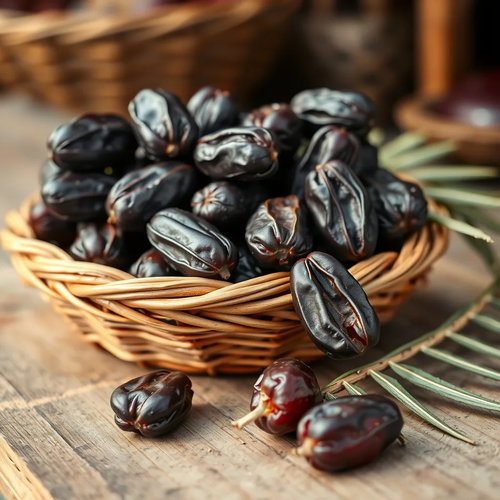
The best-known Iranian date internationally. Dark, soft, fleshy, sold at rutab stage with roughly 15-18% moisture. Grown principally around Bam and Jiroft in Kerman province.
The defining commercial fact: Mazafati is a chilled product. It needs roughly 0 to 4°C for retail-condition shelf life, and frozen storage at -18°C for long holding. Shipped or stored warm, it darkens, ferments, weeps sugar syrup and goes sour. More first-time Mazafati imports are ruined by a break in the cold chain than by anything the packhouse did.
Graded by size (typically large/medium/small or by count) and by colour uniformity. Retail packs of 500 g-1 kg are the volume format.
Piarom (Maryami)
The premium product. Long, slender, dark brown, semi-dry, low moisture (typically well under 15%), with a distinctive caramel character. Grown mainly around Hajiabad in Hormozgan. Naturally low-moisture, which means good ambient shelf stability without refrigeration – a real logistical advantage over Mazafati.
Commands a substantial premium and serves premium retail, gifting and health-food channels. Also the variety most likely to be mis-sold: cheaper dark semi-dry dates get offered as Piarom. Insist on origin documentation and an approved control sample.
Zahedi
Dry, firm, golden to light brown, low moisture, very low price. The industrial workhorse: date paste, date syrup, liquid sugar, bakery filling, animal feed and industrial fermentation. Also sold as a cheap ambient retail date in some markets.
If you are buying for processing, Zahedi is usually the right economic answer and the variety where a container of “premium” fruit is money wasted.
Sayer (Stamaran)
Semi-dry, brown, the classic Khuzestan bulk export date and historically Iran’s highest-volume export variety. Good ambient stability, widely supplied pitted for industrial use. Sits between Zahedi and Piarom on both quality and price – the default answer when a buyer wants volume without a cold chain.
Others worth knowing
- Kabkab (Bushehr) – soft, high moisture, heavily used for syrup and paste.
- Rabbi (Sistan-Baluchestan) – semi-dry, dark red-brown, good ambient stability.
- Shahani (Fars) – soft to semi-dry, largely domestic.
- Barhi – sold fresh at khalal stage, yellow and crisp; a specialty chilled/frozen export.
Date derivatives
Iranian processors also supply date paste, date syrup (date honey), date liquid sugar, chopped and diced dates, date powder/sugar, pitted dates and date pit powder (used as a caffeine-free coffee substitute). These are frequently the better margin play for a food manufacturer, and they ship at ambient.
Quality, Compliance & Testing
This is the section that decides whether your container clears. Set these in the contract, against your own destination, before you order.
- Live insect infestation. The single most common rejection cause for dates, ahead of everything else. Dates are attacked by the fig moth (Ephestia) and saw-toothed grain beetle among others, and warm storage lets a small infestation become a visible one in transit. Require a documented disinfestation treatment and a zero-live-insect specification.
- Disinfestation method – specify it. Methyl bromide is being phased out globally and is banned or restricted in many destinations. The realistic alternatives are phosphine fumigation, controlled/modified atmosphere, steam or heat pasteurisation, and freezing at -18°C for a defined holding period. Freezing and steam are the cleanest for residue-sensitive buyers. Ask what the packhouse actually has installed, not what it can arrange.
- Pesticide residues (MRLs). A frequent cause of EU notifications on this category. Require a multi-residue screen against your destination’s MRL list, on the shipped lot.
- Moisture. Specify a band, not a maximum alone. Too high and it ferments; too low and the fruit is hard and you paid for water you did not get.
- Microbiology – yeasts and moulds, Salmonella, E. coli, total plate count. Essential if the fruit enters a food-manufacturing plant.
- Aflatoxin and ochratoxin. Lower structural risk than figs, but not zero, and some destinations test. Confirm your market’s limits.
- Heavy metals where the destination requires it.
- Foreign matter, immature and damaged fruit, and pit fragments in pitted product. Specify maximum percentages and an AQL. Pit fragments in pitted dates are a serious matter for a food manufacturer – specify a metal-detection and X-ray step if the fruit goes into a processed product.
- Documents: Certificate of Origin, Phytosanitary Certificate, Health Certificate, fumigation certificate, plus Halal and organic where relevant.
- Packhouse systems: ISO 22000 and HACCP at minimum; BRCGS or IFS if you supply European retail.
The laboratory must be independent of the supplier and instructed by your side. A seller-commissioned certificate is a starting point for discussion, not evidence.
Cold Chain – the Part Most Buyers Get Wrong
For Mazafati and other rutab-stage fruit, temperature is not a packaging preference, it is the product specification:
- Chilled (0-4°C) for retail-condition fruit moving on a short route.
- Frozen (-18°C) for long transit, long holding, or any route where reefer continuity cannot be guaranteed. Frozen Mazafati thaws back to good condition; warm Mazafati does not recover.
- Reefer container with a downloadable temperature log, and a contractual right to reject on the log. Specify the set point and require the data logger record as a shipping document.
- The weak points are not the vessel. They are the packhouse loading bay, the port dwell time and the destination unloading. Ask who is responsible at each handover, and write it into the contract.
Piarom, Zahedi, Sayer and Rabbi are ambient-stable and do not need this – which is exactly why they are often the better first purchase for a buyer without established cold-chain logistics.
Packaging & Marking
- Mazafati retail: 500 g-1 kg trays or tubs, chilled, often in printed cartons for retail-ready display.
- Mazafati bulk: 5 kg cartons or trays, chilled or frozen.
- Piarom: 5 kg or 10 kg cartons, frequently retail-ready for the premium channel.
- Sayer and Zahedi: 10 kg or 20 kg cartons with food-grade liner; pitted product often in 10 kg blocks or free-flow.
- Paste and syrup: 20-25 kg pails, drums, or aseptic bag-in-box for industrial supply.
- Modified atmosphere or vacuum where oxidation or insect re-infestation is a concern.
Mark with product, variety, grade and size, net and gross weight, lot number, production and best-before dates, storage temperature requirement, origin, packhouse code and the importer’s reference. Put the required storage temperature on the carton in the destination language – a warehouse that does not know it is a chilled product will put it on an ambient rack.
MOQ, Lead Time & Incoterms
MOQ is driven by container economics. A 20’ container of cartoned dates runs roughly 18-20 tonnes; most exporters quote from one full container, and mixed containers across two or three varieties are usually available at a modest premium – a sensible structure for a first order. LCL is possible for trials at a per-kilo penalty.
Lead time is dominated by the harvest calendar, not the packhouse. Iranian dates are harvested from roughly August into October, with exact timing varying by variety and region. Fruit bought in-season out of fresh crop is better, cheaper and faster to assemble. Fruit bought in late spring is last year’s crop, more variable, and slower. Once a lot is agreed, expect roughly 2-4 weeks from contract to loading, plus time for disinfestation and any retail packaging.
Incoterms: FOB Bandar Abbas is the normal sea-freight basis. CFR/CIF to a named port is widely available. EXW is common for overland movement to Iraq, Turkey, Afghanistan and Central Asia. Whichever you use, fix in the contract who commissions and pays for the laboratory testing and the pre-shipment inspection, who owns the reefer set point, and where risk transfers.
Price & Total Cost of Ownership
The spread between the cheapest and the most expensive Iranian date offer in a given week is enormous, and most of it is real. What drives it:
- Variety. Piarom is a multiple of Zahedi. Comparing “Iranian dates” prices without naming the variety is meaningless.
- Crop year and harvest size. A short crop moves the market; so does regional drought or an unseasonal rain at harvest.
- Grade and processing level. Field-run, washed and sorted, optically sorted, hand-selected, pitted – each step adds cost and removes risk.
- Disinfestation method. Steam pasteurisation and freezing cost more than fumigation and are worth it for residue-sensitive channels.
- Cold chain. Reefer freight and chilled storage are a significant, often underestimated line on Mazafati.
- Packaging. Retail-ready trays versus bulk cartons is a large difference.
- Currency and payment route. Both can move the effective price several percent.
The TCO framing is blunt: a container that is 10% cheaper and arrives with live insects, a failed MRL or a broken cold chain costs you the goods, the freight, the destruction or re-export, and the customer. Buy the treatment and the certificate, not the discount.
How IranLocalize Reduces Your Risk
- Packhouse verification. We visit the facility, confirm it packs rather than re-sells, and check what disinfestation and cold storage it actually has installed and running.
- Specification drafting. We turn your requirement into numbers: variety, maturity stage, moisture band, size/count, defect AQL, treatment method, MRL and microbiology limits tied to your destination.
- Sampling from current production, with retained control samples on both sides.
- Independent laboratory testing – accredited lab, instructed by us, on the shipped lot.
- Cold-chain design and enforcement – set point, data loggers, handover responsibilities, and a contractual right to reject on the log.
- Contracting with clear quality clauses, penalties and rejection rights.
- Pre-shipment inspection – carton-level checks, weight verification, insect inspection, temperature verification at loading, with photo and video evidence.
- Logistics and documentation, including phytosanitary and health certification for your destination.
RFQ Checklist – Send This to Get a Precise Quote
- Variety – name it. Mazafati, Piarom, Zahedi, Sayer, Rabbi, Kabkab, or a derivative.
- Maturity stage and moisture band required.
- Quantity, and whether you want a mixed container.
- Destination country and port – this determines the compliance limits.
- Pitted or unpitted; whole, chopped, paste or syrup.
- Size grade or count per kilogram.
- Disinfestation method you will accept – and any you will not.
- MRL, microbiology and mycotoxin limits you must meet.
- Defect and foreign-matter tolerances, plus pit-fragment limits if pitted.
- Packaging – bulk carton, retail tray, private label yes/no.
- Temperature regime – ambient, chilled or frozen.
- Certification required – ISO 22000, HACCP, BRCGS/IFS, Halal, organic.
- Incoterm, target shipment window, and payment route available to you.
- Shelf-life requirement at destination.
Buyer Mistakes and How to Avoid Them
- Buying Mazafati without a cold chain. The commonest expensive mistake in this category. Fix: buy frozen, or buy an ambient-stable variety instead.
- Saying “dates” instead of naming the variety. Fix: name it; the price range across varieties is several-fold.
- Not specifying the disinfestation method. You may receive fumigated fruit your market will not accept. Fix: specify the method and require the certificate.
- Ignoring the maturity stage. “Fresh” means different things to you and to the exporter. Fix: specify khalal, rutab or tamar, plus moisture.
- Accepting a seller-commissioned lab certificate. Fix: independent accredited lab, instructed by your side, on the shipped lot.
- Buying “fresh crop” in June. Fix: contract the crop year explicitly and buy in season.
- Overlooking pit fragments in pitted product. Fix: specify a limit and require metal detection or X-ray.
- Skipping pre-shipment inspection. In this category it is the cheapest insurance available, by a wide margin.
FAQs
Which Iranian date should I start with? If you have no cold chain, start with Sayer or Zahedi – ambient-stable, high volume, forgiving. If you are targeting premium retail and can handle logistics, Piarom is ambient-stable and distinctive. Mazafati only once your cold chain is genuinely established.
Does Mazafati really need refrigeration? Yes. It is a rutab-stage fruit at 15-18% moisture. At ambient in a warm climate it darkens, ferments and weeps. Frozen at -18°C it holds for a long time and thaws back well.
How do I avoid an insect problem? Specify zero live insects, require a disinfestation treatment you name, verify the packhouse actually has that equipment, and inspect before loading. Freezing and steam pasteurisation are the cleanest methods for residue-sensitive markets.
Is methyl bromide still used? It is being phased out internationally and is restricted or banned in many destinations. Do not accept it by default – specify phosphine, controlled atmosphere, steam or freezing instead, and confirm what your destination permits.
Can I buy paste or syrup instead of whole fruit? Yes, and for a food manufacturer it is often better economics – it ships at ambient, has no cosmetic grading risk, and Zahedi or Kabkab feedstock is inexpensive. Specify Brix, moisture, colour and microbiology.
What is a realistic minimum order? One 20’ container is the efficient unit; a mixed container across two or three varieties is a good first structure. Smaller trial quantities are possible at a per-kilo premium.
How are payments handled given banking restrictions? This depends on your jurisdiction and bank and must be resolved before the contract, not after. We will tell you plainly what routes are and are not workable for your situation rather than promise a channel that does not exist.
Collaboration Workflow with IranLocalize
- Send your RFQ using the checklist above, with the destination country named.
- We shortlist two or three verified packhouses and return technical and commercial proposals.
- Sample approval from current production, with retained control samples on both sides.
- Laboratory testing at an accredited independent lab against your destination’s limits.
- Contract with hard numeric specs, treatment method, temperature regime, Incoterms, inspection rights and penalties.
- Production, treatment and pre-shipment inspection with photographic and video evidence.
- Shipping and documentation, with reefer set point and data loggers where applicable.
- Post-shipment review – destination QC results feed back into the next order’s specification.
Executive Summary
- Why Iran: the world’s second-largest producer, with a varietal range – soft, semi-dry, dry, premium, industrial – that almost no other origin offers from one source in one season.
- What actually matters: variety and maturity stage, moisture band, disinfestation method, MRLs, and temperature regime – specified as numbers and verified on the shipped lot.
- Where buyers lose money: importing Mazafati without a cold chain, leaving the disinfestation method unspecified, and skipping the inspection.
- Why IranLocalize: we verify the packhouse and its actual equipment, write the specification, commission independent testing, design and enforce the cold chain, and inspect the loading.
Ready to evaluate date packhouses in Iran? Send us your variety, destination market and compliance limits. We will come back with verified options, current-crop samples, and a firm timeline.