

Key Products
High Temperature Cam Followers from Iran: Stud & Yoke Track Rollers for Ovens, Kilns and Furnaces
Why Source High Temperature Cam Followers from Iran?
A standard cam follower is a commodity. A cam follower that has to run at 250°C, inside an oven, on a conveyor that cannot be stopped without shutting down a production line, is not. It is a component where the difference between a correct part and a plausible-looking one shows up as an unplanned shutdown, and where most buyers discover the difference the hard way.
Iran’s relevance here is specific and worth stating plainly. The country runs one of the world’s largest ceramic and sanitaryware tile industries, a substantial cement sector, significant steel and glass capacity, and a large textile finishing base – which means Iranian plants consume heat-stabilised rollers in real volume, and the machining and heat-treatment shops that serve them have been solving this problem domestically for years. Add competitive machining labour, a willingness to run modest quantities to a drawing, and short overland freight to Iraq, Turkey, the Caucasus and Central Asia, and there is a genuine sourcing case.
It is also a category where you should be more sceptical than usual, and we will say so directly: the high-temperature specification is invisible. A heat-stabilised roller and an ordinary one are the same part, in the same black oxide finish, with the same catalogue number style. The difference lives in the heat treatment, the grease, the seal material and the internal clearance – none of which you can photograph. Anyone offering “high temperature cam followers” without being able to state the stabilisation class, the grease type and the tested clearance is selling you a standard part with an adjective attached.
That is exactly the gap IranLocalize exists to close: we verify the shop, pin the specification to numbers, commission independent hardness and dimensional testing, and inspect before loading.
Product Overview & Use Cases
A cam follower (also called a track roller or cam roller) is a heavy-duty rolling bearing with a thick-walled outer ring designed to run directly against a track, cam or rail. Two basic forms:
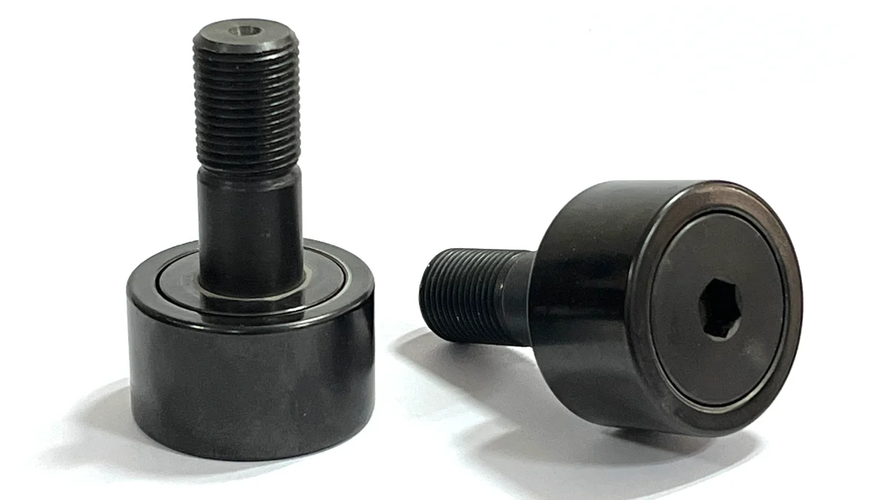
- Stud type (the parts in the photograph above) – an integral threaded stud acts as both the axle and the mounting feature, threading straight into a tapped hole or through a plate with a nut. A hex socket in the stud end allows tightening after installation. This is the common choice where the roller mounts to a bracket or frame.
- Yoke type – no stud; a through-bore mounts on a separate pin, usually supported on both sides. Used where loads are higher or a clevis mounting is available.
Where high-temperature versions actually get used
- Industrial oven and dryer conveyors – bakery tunnel ovens, powder-coating and paint-bake lines, curing ovens.
- Kiln cars and furnace door mechanisms – ceramic and tile kilns, brick kilns, heat-treatment furnaces.
- Textile stenter frames – chain guide rollers running continuously through heated chambers.
- Glass tempering and annealing lines.
- Steel mill handling equipment – roller tables, transfer cars, coil handling near hot product.
- Foundry and casting line conveyors.
- Sterilisation and autoclave equipment at the lower end of the range.
If you also buy other precision-machined industrial components from Iran, see our guide to brass manifolds and distribution collectors.
What “High Temperature” Actually Means – and Why It Is Four Separate Decisions
This is the section that separates a working part from a warranty claim. “High temperature” is not one specification. It is four, and a supplier who only addresses one of them has not answered your question.
1. Heat stabilisation of the rings and rollers
Bearing steel is dimensionally stabilised by a supplementary heat treatment after hardening, which transforms retained austenite before it can transform in service. Run a bearing above its stabilisation temperature and the structure changes, the part grows or shrinks, clearance disappears, and it seizes or cracks.
Classes are designated S0, S1, S2, S3 and so on – but the numbering is not consistent between manufacturers. One maker’s S1 is 200°C; another’s S1 is 150°C. A third uses SN for the untreated 120°C baseline.
Never accept a stabilisation class on its own. Require the class AND the temperature in °C, in writing, on the quotation. This single sentence prevents the most common failure in this category.
Note also the trade-off: higher stabilisation reduces attainable hardness, which reduces load capacity and fatigue life. A part stabilised to 300°C will not carry what the same part stabilised to 150°C carries. Ask for the derated dynamic load rating at your operating temperature – not the room-temperature catalogue figure.
2. Lubrication
Ordinary lithium grease carbonises somewhere around 120-150°C, at which point it stops lubricating and starts acting as an abrasive. Options above that:
- PFPE (perfluoropolyether) grease – usable roughly -20°C to 300°C, chemically inert, the standard answer for continuous oven service. Expensive, and worth it.
- Polyurea and synthetic hydrocarbon greases – good to roughly 180-200°C, a sensible middle option.
- Graphite or MoS₂ solid-lubricant packs – for the top of the range, or where grease contamination of the product is unacceptable.
- Self-lubricating graphite bushing designs – no rolling elements at all; used above roughly 350-400°C where no grease survives. Lower speed and load capability, but effectively maintenance-free.
- Relubricable designs with a grease fitting through the stud, where a maintenance schedule exists and is actually followed.
3. Seals
Standard nitrile (NBR) seals harden and crack well below 150°C. At elevated temperature the realistic choices are Viton/FKM (to roughly 200-250°C), PTFE, or no contact seal at all – a labyrinth or shielded arrangement that accepts some contamination in exchange for surviving the heat. Removing the seal also removes drag, which matters on a long conveyor with hundreds of rollers.
4. Internal clearance
Steel expands. If the inner and outer rings sit at different temperatures – which they always do when the outer ring is against a hot track and the stud is bolted to a cooler frame – a bearing built to standard clearance will lose all of it and preload itself to death.
High-temperature parts need increased internal clearance (C3, C4 or a specified value), and the correct choice depends on your actual temperature differential. Tell the supplier the operating temperature and the mounting arrangement, not just “hot”.
Variants and Specifications That Matter
- Outer ring profile: crowned (slightly convex) tolerates minor misalignment between roller and track and is the usual default; cylindrical gives a larger contact area and higher load capacity but demands accurate alignment. Getting this wrong causes edge loading and rapid track wear.
- Roller complement: full complement needle rollers for maximum load at lower speed; caged for lower friction, higher speed and a larger grease reservoir at reduced load rating. At high temperature, cage material becomes its own question – polyamide cages are out; steel or brass cages are the realistic options.
- Stud thread: metric (M12, M16, M20, M24) or imperial. State the standard and pitch. Hex socket size in the stud end matters for installation access.
- Eccentric collar versions for adjusting roller position against the track during setup – extremely useful on conveyor installations, and worth specifying up front.
- Sizes: outer diameters from roughly 16 mm to 150 mm cover most industrial conveyor and door applications.
- Finish: black oxide is standard (as shown above); zinc or chrome plating is available but check plating behaviour at your temperature – some coatings degrade before the steel does.
- Bore and mounting details for yoke type: bore diameter, width, and whether thrust washers are supplied.
Quality, Compliance & Testing
- Hardness testing on the outer ring raceway – the single most informative test. Require a Rockwell C report on the production lot, tested after heat stabilisation.
- Heat stabilisation verification. Ask what temperature and duration was used and require documentation of the treatment, not just a class letter.
- Material certificate – typically through-hardening bearing steel (100Cr6 / AISI 52100 equivalent) for rings and rollers, case-hardened alloy steel for studs.
- Dimensional and geometric inspection – outer diameter, crown radius where applicable, stud thread gauging, concentricity, and measured radial internal clearance.
- Grease certification – the actual product name and its temperature range, on paper. “High temperature grease” is not a specification.
- Seal material certificate where seals are fitted.
- Running test – a sample run under load at temperature is worth requesting for a first order on a critical application. It is unusual to ask for. Ask anyway.
- Factory systems: ISO 9001 at minimum; ask about gauge calibration and whether heat treatment is in-house or subcontracted, and if subcontracted, to whom.
Packaging & Marking
- Individually oiled and wrapped in VCI paper or sealed poly – bearing steel rusts, and a container crossing the Gulf in summer is a humidity chamber.
- Individual boxes with the full designation, stabilisation class and temperature in °C, grease type, clearance, and lot number printed on the label.
- Threads protected; studs must not knock against each other in transit.
- Master cartons weight-limited, palletised and strapped.
- Include the grease and stabilisation data on the box, not only on the invoice. Two years later a maintenance technician holding the box is the person who needs to know.
MOQ, Lead Time & Incoterms
MOQ is typically set per size and specification. For a standard catalogue size in a high-temperature build, expect a realistic minimum in the low hundreds of pieces per variant; custom sizes or drawings push it higher because heat-treatment batch economics, not machining, set the floor.
Lead time typically runs 4-8 weeks, longer than a standard bearing because heat stabilisation is an extra process step, PFPE grease is frequently imported, and non-standard seals may need to be sourced. A first order with first-article approval and a running test should be planned at the longer end.
Incoterms: FOB Bandar Abbas for sea freight; EXW is common and attractive for overland shipment to Iraq, Turkey, Armenia, Azerbaijan and Central Asia. CFR/CIF is available. Fix in the contract who commissions and pays for the hardness testing and pre-shipment inspection, and at what point risk transfers.
Price & Total Cost of Ownership
High-temperature cam followers cost meaningfully more than standard ones – typically a substantial multiple, not a small premium. The cost drivers:
- Heat stabilisation – an extra furnace cycle, plus the yield loss from tighter post-treatment dimensional control.
- Grease – PFPE is genuinely expensive per gram, and it is a real line item on a small part.
- Seals – FKM and PTFE cost multiples of nitrile.
- Derating – you often need a physically larger roller to carry the same load at temperature, which raises the per-unit price before any of the above.
- Batch size – heat treatment has a minimum economic batch; small orders carry it disproportionately.
The TCO case is unusually clear here, and it is the argument to make internally when someone challenges the price. A roller on an oven conveyor is not replaced during a coffee break. Replacement means cooling the oven, entering it, changing the part, and reheating – typically a shift of lost production, sometimes more. Against a single avoided unplanned shutdown, the entire price difference across hundreds of rollers is usually trivial. Buy the specification.
How IranLocalize Reduces Your Risk
- Supplier verification. We visit the shop, confirm it machines and heat-treats rather than re-boxing imported bearings, and establish whether heat treatment is in-house or subcontracted – and to whom.
- Specification drafting. We convert your application into numbers: operating and peak temperature, stabilisation class and °C, grease product, seal material, internal clearance, crown profile, load and speed.
- Independent testing. Rockwell hardness on the production lot, dimensional and clearance measurement, thread gauging.
- First-article approval and, where the application justifies it, a witnessed running test at temperature.
- Contracting with hard specs, inspection rights, penalties and milestones.
- Pre-shipment inspection with photographic and video evidence, label verification, and loading supervision.
- Straight answers. If what you need is beyond what we can verify in Iran, we will tell you that rather than place the order and hope.
RFQ Checklist – Send This to Get a Precise Quote
- Type – stud or yoke; eccentric collar yes/no.
- Continuous operating temperature and peak temperature, in °C.
- Whether the whole assembly is hot, or only the track – this drives the clearance decision.
- Outer diameter, width, stud diameter and thread (or the designation you currently buy).
- Crowned or cylindrical outer ring.
- Radial load, any axial load, and speed (rpm or surface m/min).
- Duty cycle – continuous, intermittent, or thermal cycling.
- Full complement or caged.
- Sealed, shielded or open – and whether contamination is present.
- Relubricable or lubricated-for-life.
- Required stabilisation class AND temperature, if you know it; otherwise state the application and let the supplier propose, then verify.
- Quantity per variant and annual forecast.
- Incoterm, destination, and target shipment window.
- The part you currently use – brand and designation. This resolves more ambiguity than any description, and lets us cross-reference dimensions exactly.
Buyer Mistakes and How to Avoid Them
- Accepting “high temperature” as a specification. It means nothing on its own. Fix: demand stabilisation class with the °C figure, grease product name, seal material and clearance – all four, in writing.
- Trusting the S-class letter alone. The numbering differs between manufacturers. Fix: always pair the class with the temperature.
- Using the room-temperature load rating. Capacity drops with stabilisation level and with operating temperature. Fix: size on the derated figure at your actual temperature.
- Leaving internal clearance at standard. The commonest cause of seizure in hot service. Fix: specify C3, C4 or a measured value based on your temperature differential.
- Ignoring the seal material. Nitrile seals fail long before the steel does. Fix: FKM, PTFE, or a deliberate shielded/open design.
- Specifying cylindrical where the track is not truly parallel. Produces edge loading and chews the track. Fix: crowned unless alignment is genuinely controlled.
- Ordering a small trial quantity and expecting catalogue pricing. Heat-treatment batch economics do not work that way. Fix: plan a realistic first order, or accept the premium knowingly.
- No first-article approval on a critical line. Fix: approve a first article and, where a shutdown is expensive, pay for a running test.
- Skipping pre-shipment inspection on a part whose defining property cannot be seen.
FAQs
What temperature can these actually run at? With appropriate stabilisation, grease and seals, continuous service to roughly 200°C is well-established, and 250-300°C is achievable with PFPE or solid lubricant and open or PTFE-sealed designs. Above roughly 350-400°C, rolling-element designs stop being practical and self-lubricating graphite bushing types are the realistic answer.
Can I just use a standard cam follower and re-grease it often? No. Grease is only one of the four variables. The rings will still be stabilised to 120-150°C, and above that the steel changes dimensionally regardless of how often you lubricate it.
Do Iranian manufacturers make these, or import and re-box them? Both exist in the market, which is precisely why verification matters. We establish which you are dealing with before you order, and we tell you plainly – a competent importer-integrator can be a perfectly good supplier, but you should know that is what you are buying.
Can I get a cross-reference to my current brand? Usually yes. Send the designation you currently buy; dimensional cross-referencing to standard series is routine. Confirm the high-temperature build separately – a dimensional match does not imply a specification match.
Crowned or cylindrical? Crowned unless your track alignment is genuinely controlled and you need the extra capacity. Crowning tolerates the small misalignments that real conveyor frames always have.
What about stainless or corrosion-resistant versions? Available, but note that martensitic stainless has lower hardness and load capacity than bearing steel, and its useful temperature range is narrower. If you need both heat and corrosion resistance, say so early – it constrains the design significantly.
What is a realistic first order? A few hundred pieces of one or two sizes, with first-article approval, is a sensible way to evaluate a supplier without committing a line to an unproven part.
Collaboration Workflow with IranLocalize
- Send your RFQ using the checklist above – ideally including the designation you currently buy.
- We shortlist verified suppliers and return technical and commercial proposals, stating clearly who manufactures and who integrates.
- First-article approval from current production, with retained control samples.
- Independent testing – hardness, dimensions, clearance, thread gauging; a running test at temperature where the application justifies it.
- Contract with hard specs, Incoterms, inspection rights, penalties and milestones.
- Production and pre-shipment inspection with photographic and video evidence and label verification.
- Shipping and documentation aligned to your destination’s requirements.
- Field feedback loop – actual service life on your line feeds back into the next order’s specification.
Executive Summary
- Why Iran: large domestic kiln, furnace, glass and textile-finishing industries that consume these parts in volume, competitive machining and heat-treatment capacity, flexibility on drawings and mid-size runs, and a real overland freight advantage to neighbouring markets.
- What actually matters: stabilisation class with the °C figure, grease product, seal material and internal clearance – four separate decisions, all invisible in a photograph.
- Where buyers lose money: treating “high temperature” as a specification, sizing on room-temperature load ratings, and leaving clearance at standard.
- Why IranLocalize: we verify whether your supplier manufactures or imports, write the specification in numbers, commission hardness and clearance testing, and inspect before loading – and we tell you honestly when a requirement is beyond what we can verify here.
Ready to evaluate suppliers in Iran? Send us your operating temperature, load, and the part designation you currently buy. We will come back with verified options, tested first articles, and firm timelines.