

Key Products
Brass Manifolds from Iran: Threaded Water Distribution Collectors
Why Source Brass Manifolds from Iran?
Iran has a deep, long-established brass forging and machining base – hot-stamping presses, bar-fed CNC lathes, and a domestic plumbing and industrial market large enough to keep those lines busy year-round. A threaded distribution manifold is exactly the kind of part that base makes well: a solid brass body, a few precisely cut female ports, a thread that has to gauge correctly every time.
For a foreign buyer the practical appeal is forged and machined brass capability at competitive machining labour rates, genuine flexibility on small and mid-size runs, and short lead times to Iraq, Central Asia, the Caucasus, the Gulf and Turkey. Against Chinese pricing Iran is not always cheaper on the headline number, but it is frequently faster on modest quantities, far more willing to run a custom port configuration, and much easier to inspect before loading.
The risk in this category is concentrated in two narrow places: the alloy and the thread. A manifold is a pressurised component, often installed where it cannot easily be reached again. Two manifolds can look identical in a photograph and differ in whether the brass survives a decade of hot water – and a thread that is nominally NPT but cut to the wrong taper will seal on the bench and weep in the field.
This page covers threaded distribution manifolds and collectors. For couplers, elbows, unions and valves, see our separate guide to brass water fittings from Iran.
Product Overview & Use Cases
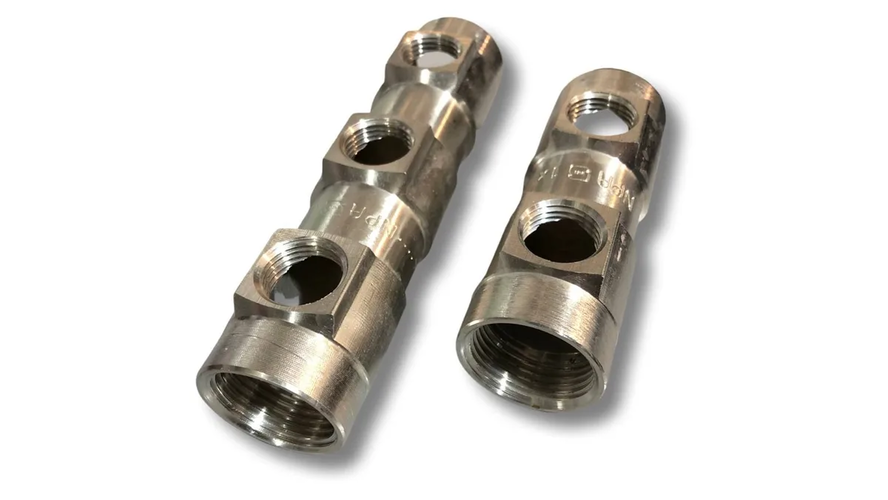
A brass manifold is a single machined body that splits one inlet into several outlets, or gathers several lines back into one. The typical form is a round or hex bar stock body with a large female thread at one or both ends and a row of smaller female ports along the flats.
Core applications
- Water distribution – home-run plumbing, where each fixture is fed from a central point rather than daisy-chained.
- Compressed air – splitting a line to multiple tools, drops or machines.
- Hydraulic and lubrication circuits – distribution blocks on machinery.
- Irrigation and agricultural systems – feeding multiple drip or sprinkler zones.
- Fuel, oil and gas lines where brass is the specified material.
- Heating systems – feeding radiator circuits or, in a flow-meter equipped variant, underfloor heating loops.
- Instrumentation and test rigs – gauge, sensor and transducer manifolds.
- OEM assemblies – built into appliances, pumps, compressors and filtration units.
The buyer set is typically plumbing and industrial wholesalers, irrigation suppliers, compressed-air distributors, and OEMs specifying a part into their own product.
Variants and Specifications That Actually Matter
Port count and layout. Standard production runs 2 to 8 outlets, in-line along one face or staggered on opposing faces. Confirm whether ports sit on one side, two sides, or alternate – this is a drawing question, not a description question.
End and port sizes. A common configuration is a 1” or ¾” female main with ½”, ⅜” or ¼” female outlets. State every size on the part, not just the main.
Thread standard – the single most important line in your RFQ.
- NPT / NPTF (ANSI B1.20.1) – tapered, sealed by thread interference, the North American and much of the industrial standard.
- BSPT (R/Rc, ISO 7) – tapered, the British and widely-used international equivalent. NPT and BSPT are not interchangeable – different thread angle (60° vs 55°) and different pitch. They will start to thread together and then fail.
- BSPP (G, ISO 228) – parallel, sealed by a washer or O-ring at the face, not by the thread.
Specify by name and standard number. Require thread gauge inspection on the production lot, not just on a first sample.
Alloy. This is the decision that determines service life:
- CW617N (CuZn40Pb2) – standard hot-stamping and machining brass. Suitable for cold water, compressed air and moderate-temperature service. This is what most Iranian manifolds are made from by default.
- DZR / CW602N (CuZn36Pb2As) – dezincification-resistant, arsenic-inhibited. Required for potable water fittings in the UK and Australia, increasingly expected in the EU. Dezincification attacks ordinary brass in hot, soft, acidic or high-chloride water above roughly 60°C, selectively dissolving the zinc and leaving a porous copper skeleton with a fraction of the original strength.
- Low-lead / “lead free” brass – necessary for the US potable market, where NSF/ANSI 372 caps wetted-surface lead at 0.25%.
If your destination requires DZR or low-lead brass, say so before pricing. Changing alloy after a price is agreed is not a negotiation, it is a different product.
Manufacturing route. Machined from solid bar gives better dimensional control and a cleaner internal bore; hot-forged then machined is cheaper at volume and perfectly sound when the forging is properly filled. Ask which route the quote assumes – it affects both price and wall thickness.
Finish. Nickel-plated is the common export finish and what most catalogue photographs show. Raw or polished brass is cheaper and entirely acceptable where the part is concealed. Chrome is available at a premium.
Marking. Size, thread standard and a manufacturer or lot mark stamped or laser-etched on a flat. Specify what you want marked – an unmarked part creates problems at the destination warehouse.
Optional additions that change the price materially: integrated ball valves on each port, end caps and plugs supplied with the unit, mounting brackets, and – for heating applications – flow meters and M30×1.5 actuator seats.
Quality, Compliance & Testing
- Alloy verification. Require a material certificate and, on a first order, independent spectrometric analysis of the actual production lot. This is the one test worth paying for every time.
- Dezincification resistance to ISO 6509 wherever DZR is specified.
- Pressure and leak testing. Ask directly: is every body tested, or a sample? For a pressurised part, 100% leak testing at the factory is the standard to hold out for – typically air-under-water at 10-16 bar, with hydrostatic burst testing on a sampling basis.
- Working rating. Confirm maximum working pressure (commonly 6-16 bar depending on size and wall) and temperature (commonly up to 90-120°C).
- Thread gauging. Go/no-go ring and plug gauges against the named standard, reported per lot.
- Porosity. The characteristic failure of a poorly filled forging or a gassy casting – it passes a quick air test and weeps under sustained pressure. Sustained-pressure testing catches it; a five-second dunk does not.
- Potable water compliance where applicable: NSF/ANSI 61 and 372 for the US, national approvals under the EU Drinking Water Directive for Europe, WRAS in the UK.
- Plating adhesion and thickness where nickel-plated.
- Factory systems: ISO 9001 at minimum; CE marking under the applicable directives for the EU.
Packaging & Marking
Brass manifolds are dense, hard-edged and perfectly capable of damaging each other in transit.
- Individual poly bags or cartons; plated parts bagged against scuffing
- Thread protectors or plugs on every port – a dinged thread makes the part scrap
- Master cartons weight-limited so they can actually be lifted, palletised and strapped
- Marking with product code, port count and sizes, thread standard, alloy, pressure rating, lot number and origin
- Accessories (caps, plugs, brackets) bagged with the unit, not loose in the carton
- For private label: artwork and plates add lead time on top of production
MOQ, Lead Time & Incoterms
MOQ is set per configuration rather than per shipment. Expect a realistic minimum in the region of a few hundred to a thousand pieces per size-and-thread variant for a catalogue item, with higher minimums where a non-standard alloy or a custom port layout is involved. Machining setup rather than hard tooling drives the floor, which is why Iranian manufacturers are generally more flexible here than in tooled categories.
Lead time typically runs 3-6 weeks for standard configurations from existing stock brass, extending where DZR or low-lead billet has to be sourced, where a custom drawing needs first-article approval, or where private-label packaging is part of the order. Nickel plating adds a few days.
Incoterms: FOB Bandar Abbas for sea freight; EXW is common for overland movement to Iraq, Turkey, Armenia, Azerbaijan and Central Asia, which is a real logistics advantage of this origin. CFR/CIF is available. Fix in the contract who commissions and pays for the alloy testing and the pre-shipment inspection, and at what point risk transfers.
Price & Total Cost of Ownership
Manifold pricing is driven mostly by brass weight, port count and machining time – not by brand. What moves the number:
- Copper and zinc prices. Brass is a commodity and a manifold is mostly metal by cost. Quotes are valid for a short window, and a long negotiation genuinely changes the price.
- Alloy grade. DZR and low-lead brass carry a real premium over CW617N, not a marketing one.
- Port count and machining operations. Price scales closely with the number of cuts; compare offers on a per-port basis, not per unit.
- Bar stock versus forging. At volume, forging saves material and money.
- Wall thickness. The quietest place to cut cost, and the one that surfaces as a burst or a weep years later.
- Finish, marking and packaging.
The honest TCO framing: a manifold that weeps is rarely a cheap failure. It is behind a wall, under a machine, or inside an appliance you have already shipped. Warranty, labour and reputation dwarf the unit price difference. Pay for the alloy certificate and the 100% leak test.
How IranLocalize Reduces Your Risk
- Manufacturer verification. We visit the plant, confirm it machines and forges rather than re-badging, and check that claimed capacity and certifications are real and current.
- Specification drafting. We convert your requirement into a drawing-level spec: alloy, port count and layout, every thread size and standard, pressure and temperature rating, wall thickness, finish, marking and packaging.
- Independent alloy testing. Spectrometric analysis on the production lot, plus ISO 6509 dezincification testing where DZR is specified.
- Leak-test verification. We confirm the 100% test is actually being run rather than claimed on a datasheet, and witness it.
- First-article and sample approval from current production, with retained control samples on both sides.
- Contracting with hard specs, inspection rights, penalties and milestones.
- Pre-shipment inspection with photographic and video evidence, dimensional and thread gauge checks, and loading supervision.
- Logistics and documentation for your destination’s import requirements.
RFQ Checklist – Send This to Get a Precise Quote
- Port count and layout – how many outlets, on how many faces, and spaced how.
- Every thread size on the part – main ends and outlets separately.
- Thread standard – NPT, NPTF, BSPT (R/Rc) or BSPP (G). Name it explicitly.
- Alloy required – CW617N, DZR/CW602N, or low-lead – and the standard driving it.
- Destination country – this determines the potable-water approvals needed.
- Working pressure and temperature rating.
- Body form – round bar, hex bar, or forged.
- Finish – nickel-plated, raw, polished or chrome.
- Marking required on the body.
- Optional components – integral valves, caps, plugs, brackets, flow meters.
- Quantity per variant, and annual forecast if there is one.
- Certification required – ISO 9001, CE, NSF/ANSI 61/372, WRAS.
- Incoterm, destination port or border crossing, and target shipment window.
- A drawing or a sample if you have one – it removes more ambiguity than any amount of description.
Buyer Mistakes and How to Avoid Them
- Writing “1 inch thread” and nothing else. NPT, BSPT and BSPP all exist at 1”. Fix: name the standard, and gauge the lot.
- Assuming “brass” means one thing. CW617N and DZR are different products with different service lives at different prices. Fix: name the alloy standard in the RFQ.
- Comparing a bare manifold to an equipped one. A price gap that looks enormous usually means one quote excludes valves, caps or plating. Fix: quote against a fixed component list.
- Accepting sample-only leak testing on a pressurised part. Fix: require and verify 100% testing, with sustained pressure rather than a momentary dunk.
- Ignoring potable-water approvals until after production. Fix: resolve certification before the first sample is cut.
- Describing the part in words when a drawing exists. Fix: send the drawing or a physical sample.
- Shipping without thread protectors. Damaged threads make the part scrap. Fix: specify plugs or caps on every port.
- Skipping pre-shipment inspection to save a few hundred dollars on a container worth far more.
FAQs
What port counts are standard? 2 to 8 is normal catalogue production. Higher counts and custom layouts are available as a machined-to-drawing part.
What is the difference between NPT and BSPT, and does it matter? It matters completely. Different thread angle and pitch – they will start to engage and then fail to seal properly. Specify one, gauge for it, and never let a supplier substitute.
Do I need DZR brass? If the part carries potable water in the UK or Australia, yes – effectively mandatory. For continuous hot service above 60°C, or soft, acidic or chloride-rich water, it is the right engineering choice regardless of market. For cold water, compressed air or moderate conditions, CW617N is normally fine.
Can Iranian manufacturers work to my drawing? Yes, and this is where the origin is strongest. Custom port layouts and sizes at moderate volumes are routine rather than exceptional.
Can Iranian manufacturers supply low-lead brass for the US market? Some can, but it requires sourcing a specific billet and is not a default. Raise it at RFQ stage – and be aware that US market access involves sanctions considerations well beyond the technical specification, which we will discuss with you frankly rather than gloss over.
Nickel-plated or raw brass? Plated where the part is visible or exposed to a corrosive environment; raw where it is concealed. Plating adds cost and a few days of lead time.
How does Iran compare with Chinese manifolds? Iran is competitive on machined brass quality and notably better on small-run flexibility, custom drawings, inspection access and overland freight to neighbouring markets. China generally wins on the largest-volume commodity orders. For a buyer in the region, the freight and lead-time advantage is often decisive.
What is a realistic first order? A mixed order across two or three size or port-count variants, in the high hundreds per variant, is a normal way to start and lets you evaluate the manufacturer across its range.
Collaboration Workflow with IranLocalize
- Send your RFQ using the checklist above, with a drawing or sample if you have one.
- We shortlist two or three verified manufacturers and return technical and commercial proposals.
- First article and sample approval from current production, with retained control samples.
- Independent testing – alloy analysis, dezincification where specified, thread gauging, leak and pressure verification.
- Contract with hard specs, Incoterms, inspection rights, penalties and milestones.
- Production and pre-shipment inspection with photographic and video evidence.
- Shipping and documentation aligned to your destination’s requirements.
- Post-shipment review – field performance feeds back into the next order’s specification.
Executive Summary
- Why Iran: a mature brass forging and machining base, real flexibility on custom drawings and mid-size runs, and a genuine freight advantage to neighbouring markets.
- What actually matters: thread standard and alloy grade, specified by name and number – plus 100% leak testing on a pressurised part.
- Where buyers lose money: the unspecified thread, the assumed alloy, and the skipped inspection. Rarely the machining itself.
- Why IranLocalize: we verify the manufacturer, write the specification, commission independent testing, witness the leak test, and inspect the loading.
Building a complete plumbing or heating package? See our guides to brass water fittings, five-layer composite water pipe and plastic plumbing fittings & valves from Iran. For precision-machined industrial components beyond plumbing, see high temperature cam followers.
Ready to evaluate brass manifold manufacturers in Iran? Send us your RFQ with port configuration, thread standard, alloy requirement and destination market – or just a drawing. We will come back with verified options, tested samples, and firm timelines.