

Key Products
Iranian Marbleite & Marble: Sourcing Slabs, Blocks and Cut-to-Size from Iran
Why Source Marbleite and Marble from Iran?
Iran sits on one of the world’s largest and most varied dimension-stone reserves, and it has been quarrying and finishing stone commercially for decades. For a foreign buyer, the practical appeal is a combination that few origins offer at once: a genuinely wide color range in a single country, large-block quarries capable of consistent repeat supply, and finishing plants with modern gangsaw and resin lines – all at price points below Mediterranean equivalents for comparable material.
A point of vocabulary matters before anything else. In Iranian trade practice, مرمریت / “marbleite” describes a dense, crystalline limestone that takes a high polish – geologically a limestone, commercially sold and specified as marble almost everywhere outside Iran. The famous Iranian “marbles” that international buyers know by name – Dehbid, Harsin, Pietra Grey, Golden Black, Persian Silk – are mostly marbleite, not metamorphic marble in the strict petrographic sense. This is not a quality problem; marbleite is typically denser and lower in absorption than true marble, which is exactly why it performs well in commercial flooring. But it does change which test standard your specifier should cite, and that is covered below.
If you buy on photographs and a per-square-metre price, you will get colour-lot drift, undeclared resin and net-backing, and thickness that is nominally 2 cm and actually 1.7 cm. If you buy on verified block source, an approved control sample, and pre-shipment inspection, Iranian stone is one of the best value-per-square-metre propositions in the market. IranLocalize exists to close that gap: we verify the quarry and the factory, lock the specification, and inspect the material before it loads.
Product Overview & Use Cases
Iranian marbleite and marble move in three commercial formats, and which one you buy changes everything downstream – price basis, risk, and who carries the yield loss.
- Blocks – raw quarry blocks, typically sold by cubic metre, graded by size, squareness, and crack content. Bought by buyers who own or contract their own gangsaw capacity and want to control yield and finish themselves.
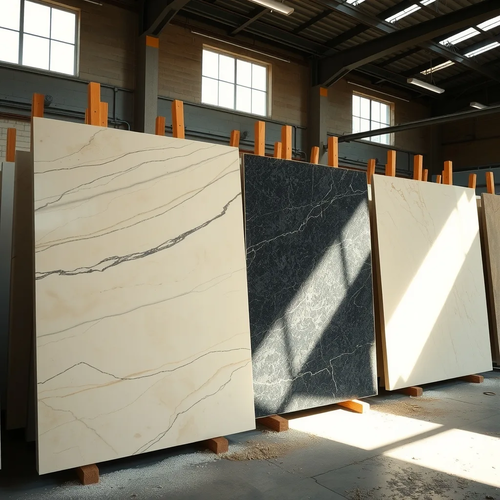
- Slabs – gangsawn and polished, standard commercial thicknesses of 1.8 cm, 2 cm and 3 cm, sold by square metre in bundles of matched blocks. The default format for distributors and fabricators.
- Cut-to-size – finished tiles and project pieces cut to a drawing: floor tiles, wall cladding, stair treads and risers, window sills, skirting, vanity tops. Bought by contractors who want the material to arrive ready to install.
Typical end uses: commercial lobby and corridor flooring, hotel and airport interiors, exterior cladding on dry-fix or adhesive systems, staircases, bathroom and kitchen surfaces, and landscape features. The dark varieties (Pietra Grey, Golden Black) are mostly decorative/feature material; the cream and beige marbleites (Dehbid, Harsin, Abadeh) are the volume workhorses for large-area flooring.
Varieties, Types and Grades
Iranian stone is sold by commercial name plus quarry plus grade, and the grade is where buyers get hurt. Naming the colour alone is not a specification.
Cream and Beige Marbleite
- Dehbid (Fars province) – creamy beige, notably uniform, faint calcite veining, low absorption and high compressive strength. The standard choice for large commercial floors where lot consistency over thousands of square metres is the real requirement. Sub-varieties include Kara Dehbid and Dehbid Cream.
- Harsin (Kermanshah province) – finer-grained and more homogeneous than Dehbid, very light cream to off-white with minimal veining. Preferred where the client wants a near-plain field.
- Abadeh (Fars province) – distinctive pinkish ground, unusual in the beige family, used where a warm tone is specified.
Dark and Feature Stone
- Pietra Grey – blackish-grey ground with irregular white veining; the single most internationally demanded Iranian stone, used for feature walls, vanity tops, and book-matched panels.
- Golden Black – dense dark matrix with golden veining, dramatic contrast material for reception and feature applications.
Grades
Most Iranian producers work to an internal A / B / C grading that is not standardised between factories. It normally reflects colour uniformity, vein regularity, and the presence of natural flaws, pits, and repaired cracks. Two factories’ “Grade A” can differ visibly. The only defence is an approved physical control sample retained by both parties, with a tolerance stated in writing – for example, “field tiles to match the retained sample within the range shown by the two corner samples.” Insist on this before the contract, not after the first container.
Quality, Compliance and Testing
For material entering the EU, natural stone for construction falls under the Construction Products Regulation: CE marking with a Declaration of Performance, tested against the standard matching the application – EN 1469 for cladding slabs, EN 12057 for modular tiles, EN 12058 for floor slabs and stair treads. For the US market, dimension-stone specification runs on ASTM: ASTM C503 for marble and ASTM C568 for limestone. This is the practical consequence of the marbleite/marble distinction above – a specifier who assumes C503 for a stone that is petrographically limestone may cite absorption limits your material is not tested against, so agree the applicable standard with your specifier before ordering.
The underlying test methods worth naming in your PO:
- ASTM C97 / EN 13755 – water absorption and bulk specific gravity. The single most predictive number for flooring durability and staining risk.
- ASTM C99 / EN 12372 – modulus of rupture / flexural strength. Governs whether a thickness is safe for the span and fixing method, especially on cladding.
- ASTM C170 – compressive strength.
- EN 14157 / ASTM C1353 – abrasion resistance, relevant for high-traffic commercial floors.
- Slip resistance (EN 16165 / ANSI A326.3) – required on many commercial floor specifications; the finish, not the stone, usually determines the result, so specify honed or flamed where wet-area slip values matter.
Ask for a test report from an accredited laboratory against the specific quarry and lot, not a generic brochure sheet for the commercial name. Where the material will be resin-treated or net-backed – routine on many Iranian slabs and entirely legitimate – have it declared in the contract, since it affects adhesive selection and the installer’s method.
Packaging and Marking
Stone damage in transit is almost always a packing failure, not a shipping accident.
- Slabs – loaded on seaworthy wooden A-frames or bundles, slabs separated by foam or cork spacers, edges protected, bundle strapped and film-wrapped. Bundles must be numbered and kept in cutting sequence so the installer can lay slabs in block order for vein continuity.
- Cut-to-size and tiles – in fumigated wooden crates compliant with ISPM 15, each crate on runners for forklift access, tiles separated by foam sheet, crate weight kept within what the destination site can handle.
- Blocks – loaded loose, chocked and lashed; block numbers painted on the face and matched to the packing list.
- Marking – each bundle or crate marked with order number, commercial name and quarry, finish, thickness, piece count and square metres, gross/net weight, and bundle sequence number.
Loading weight is the discipline point: a 20’ container is normally the right unit for stone because the payload limit is reached well before the volume limit – plan for roughly 25 tonnes and have the factory confirm gross weight per bundle in advance so the container is not rejected at the port.
MOQ, Lead Time and Incoterms
- MOQ – in practice one 20’ container per item is the working minimum for slabs and cut-to-size; smaller trial quantities are possible by consolidating several items into one container. Blocks are sold from a few cubic metres upward.
- Lead time – commonly 3-6 weeks for a standard slab order from an available block, longer where the block must be quarried, or where cut-to-size requires a shop drawing cycle. Winter weather closes some high-altitude quarries, so seasonality is real; plan Q1 orders against stock rather than fresh extraction.
- Incoterms – FOB Bandar Abbas is the usual basis for sea freight; CIF to the destination port is straightforward to arrange. EXW ex-factory is offered but leaves a foreign buyer managing inland transport and export clearance in Iran, which we do not recommend unless you already have a local agent.
Confirm at contract stage: whether square metres are net (measured pieces) or gross (bounding rectangle), how broken pieces are credited, and the tolerance on thickness and calibration.
Price and Total Cost of Ownership
Iranian marbleite and marble typically price meaningfully below Turkish, Italian, and Spanish equivalents of comparable appearance, and the gap is widest in the mid-to-upper commercial grades. We do not publish fixed figures, because a per-square-metre price is only meaningful against a named quarry, grade, thickness, and finish – any number quoted without those is marketing.
What actually drives your landed cost:
- Format – cut-to-size costs more per square metre than slabs, but transfers yield loss and fabrication labour to the supplier; on a project with heavy cutting, it often lands cheaper overall.
- Thickness – 3 cm costs more than 2 cm both in material and in freight, and freight is weight-driven on stone.
- Grade and uniformity – the premium for a tight colour lot across a large floor is real and worth paying when the alternative is a visibly patchy result.
- Finish – polished, honed, brushed, leathered, flamed, bush-hammered; each has a different cost and a different slip value.
- Freight and weight – stone is heavy and the container hits its weight limit first, so optimising thickness and packing is the largest single lever on landed cost.
- Breakage and rejects – the cost buyers forget. A 5% breakage rate on an underpacked container erases any unit-price saving.
How IranLocalize Reduces Your Risk
We act as your own presence in Iran, not as a trader with stock to move:
- Quarry and factory verification – we confirm the material actually comes from the quarry it is named after, that the producer holds the block rights or a reliable supply relationship, and that the finishing plant has the gangsaw and polishing capacity for your volume.
- Specification lock – commercial name, quarry, grade, thickness and calibration tolerance, finish, edge treatment, resin/net treatment, and the retained control sample, all written into the contract.
- Block and slab selection – where the job needs it, we select the block or approve the slab bundles physically before cutting, with photographs of the actual material under consistent lighting.
- Contracting – enforceable terms with payment milestones, rejection criteria, and remedy for off-spec material, in a form that works given Iran’s banking and payment realities.
- Pre-shipment inspection – thickness measured at multiple points, colour checked against the retained sample, piece count and square metres verified, packing and bundle sequence checked before the container closes, with photographic evidence.
- Logistics and documents – packing list, certificate of origin, test reports, ISPM 15 fumigation certificate, and container weight documentation aligned with the destination’s requirements.
RFQ Checklist
Send us these and you will get a precise quote rather than a range:
- Commercial name and quarry (or a photo of the reference material, and we will identify it)
- Format – block, slab, or cut-to-size
- Thickness – 1.8 / 2 / 3 cm, and calibration requirement
- Finish – polished, honed, brushed, leathered, flamed, bush-hammered
- Quantity – square metres or cubic metres, and whether it is a one-off or a repeating programme
- For cut-to-size – drawings with piece sizes, edge details, and any stair/sill profiles
- Grade and uniformity requirement – how tight the colour lot must be
- Application – floor, cladding, wet area, exterior; and any slip-resistance or absorption limit your specifier imposes
- Standard to be certified against – EN 1469 / EN 12057 / EN 12058, or ASTM C503 / C568
- Destination port and Incoterm
- Target delivery window
Buyer Mistakes and How to Avoid Them
- Buying a colour name, not a quarry. “Dehbid” is sold by many producers from many pits of varying quality. Name the quarry and retain a sample.
- Accepting slab photos as approval. Stone photographed wet or under warm light looks nothing like the installed floor. Ask for dry material under neutral light, or approve a physical sample.
- Ignoring bundle sequence. Slabs installed out of block order on a large floor produce visible banding. Require numbered bundles in cutting sequence.
- Assuming nominal thickness. “2 cm” routinely arrives at 1.7-1.8 cm. State the tolerance and measure at inspection.
- Not declaring resin and net-backing. Legitimate and common, but it must be known before the installer chooses an adhesive.
- Specifying polished stone for a wet floor. A slip-resistance failure on a hotel lobby is an expensive, visible problem. Match the finish to the application.
- Over-loading the container. Weight limits bite before volume does; a rejected or re-stuffed container costs more than the stone it saved.
- Underestimating payment friction. Iran’s banking situation means payment routing must be planned into the deal from the start, not improvised at shipment.
FAQs
Is Iranian marbleite the same thing as marble? Commercially yes, geologically no. Marbleite is a dense crystalline limestone sold internationally as marble. It is often lower in absorption than true marble, which is an advantage for commercial flooring – but your specifier should confirm whether the material is to be certified under the marble standard (ASTM C503) or the limestone one (ASTM C568).
Can you supply CE-marked stone with a Declaration of Performance? Yes, where the producer is set up for it or is willing to have the material tested. We arrange testing against the relevant EN standard for your application and confirm the DoP before shipment, rather than discovering the gap at customs.
What is the realistic minimum order? One 20’ container per order, though we can consolidate several items and even several producers into a single container for a trial shipment.
Can I get the same colour again in six months? Only if the block comes from the same quarry and, ideally, the same working face. This is exactly why we verify the quarry rather than the trader: repeat-order consistency is a supply-chain property, not a product property. For phased projects, we recommend reserving blocks up front.
Do you handle cut-to-size to our drawings? Yes. We manage the shop drawing cycle with the factory, confirm piece sizes and edge profiles against your drawings, and inspect a first-article piece before full production.
How is the material inspected before it ships? Physically, at the factory, before the container closes: thickness at multiple points, colour against the retained control sample, piece and square-metre count, finish quality, and packing integrity – documented with photographs you receive before payment milestones release.
Collaboration Workflow with IranLocalize
- Send your RFQ using the checklist above.
- Material identification and shortlist – 2-3 verified quarry/factory options with photographs of current material.
- Sample approval – physical control samples shipped and retained by both parties.
- Contract – hard specification, Incoterms, inspection rights, rejection criteria, and payment milestones.
- Production – block selection or bundle approval, then cutting and finishing to the agreed spec.
- Pre-shipment inspection – documented, with photographic evidence.
- Shipping and documents – packing, weight verification, and the full document set for your destination.
- After-sales – installation feedback, and block reservation for the next phase where the programme repeats.
Executive Summary
- Why Iran: exceptional colour range from a single origin, large-block quarries for repeat supply, modern finishing capacity, and pricing well below Mediterranean equivalents.
- What matters: naming the quarry, not the colour; an approved retained control sample; declared thickness and treatment; and inspection before the container closes.
- Why IranLocalize: we verify the quarry and the plant, lock the specification in an enforceable contract, and inspect your stone physically – with no stock of our own to push.
Sourcing a broader stone package for the same project? See our overview of Iranian natural stones for wholesale – travertine, granite, and onyx alongside marble – and, for combined construction-material orders, bricks from Iran.
Ready to price your stone package? Send us the RFQ checklist above. We will come back with verified producers, real photographs of current material, and firm timelines.