

Key Products
Ammonium Nitrate & CAN from Iran: Sourcing a Regulated Nitrogen Fertiliser
Read This Section First
Ammonium nitrate is an excellent nitrogen fertiliser and a controlled dual-use substance. It is the one product on this site where the regulatory work is larger than the sourcing work, and where we will sometimes tell a prospective buyer that we cannot help them.
We handle this category only for legitimate, documented agricultural and industrial buyers who can satisfy their own jurisdiction’s licensing and end-user requirements. Every enquiry goes through end-user verification and destination licensing checks before we quote, and we will not proceed where those cannot be satisfied. If that is a problem for a prospective counterparty, it is a problem in the right place.
For many buyers, calcium ammonium nitrate (CAN) or an ammonium sulphate and urea combination is the better route – lower regulatory burden, easier freight, and frequently better agronomy. We will say so where it applies rather than sell the harder product.
Why Source from Iran?
Iran has a mature nitrogen petrochemical sector. The chain is fully domestic: natural gas to ammonia, ammonia to nitric acid, ammonia and nitric acid to ammonium nitrate, with established plants running the full sequence alongside urea production.
For regional buyers – Iraq, Turkey, Afghanistan, Central Asia and the Caucasus – overland freight is short, and these are substantial agricultural markets. That is the genuine commercial case.
The genuine constraint, stated plainly: this category attracts more export scrutiny, more end-user documentation and more banking friction than anything else we source. Timelines are longer and paperwork is heavier. Plan accordingly.
If your nitrogen requirement does not specifically need nitrate, see our guides to ammonium sulphate and, for potassium with sulphur, potassium sulphate.
Regulatory Reality
This is the heart of the page. Get these wrong and nothing else matters.
Explosives precursor controls. In the EU, Regulation (EU) 2019/1148 on the marketing and use of explosives precursors restricts ammonium nitrate containing 16% or more nitrogen by weight in relation to ammonium nitrate. Material at or above that threshold may not be made available to, introduced by, or possessed or used by members of the general public – it is restricted to professional users and economic operators, with obligations on the supply chain including verification of professional status and reporting of suspicious transactions, disappearances and thefts. Most jurisdictions outside the EU have equivalent regimes; the UK, US, Australia, Turkey and the Gulf states all control it in some form.
Know your obligations as the importer. You will typically need to verify and document your customers’ professional status, keep records, and report suspicious enquiries. This is not optional paperwork, and in most jurisdictions it carries personal liability.
Detonation resistance. High-nitrogen ammonium nitrate fertiliser placed on the EU market must be detonation-resistance tested and accompanied by the required documentation under the Fertilising Products Regulation, together with thermal-cycling conditioning. Confirm the current requirements and test protocol for your destination and require the certificate on the shipped lot – not a generic annual document.
Transport. Ammonium nitrate based fertiliser is typically classified as an oxidising substance, Class 5.1 (UN 2067 for the fertiliser grades, with other UN numbers for other forms and concentrations). This determines packaging, placarding, documentation, stowage, segregation and which carriers will take it. Some formulations fall into more restrictive classifications. Get the classification confirmed in writing for your exact product and route before booking anything.
Storage and handling. Ammonium nitrate is an oxidiser. Contamination with fuels, oils, organic matter, chlorides, or certain metals substantially increases its hazard, and confinement under fire is the condition behind the major historical disasters. Your customers need to store it separated from combustibles, in a dedicated, well-ventilated, non-combustible space, away from heat sources. If you are supplying a channel that will not do this, that is a reason to decline the business.
Import licensing. Most destinations require an import permit and end-user documentation in advance. Lead times of several months are normal. Start this before anything else.
Product Options – and Why CAN Is Usually the Better Answer
Ammonium nitrate (AN), typically 33.5-34.5% N. Half the nitrogen as immediately available nitrate, half as ammoniacal – an efficient, fast-acting nitrogen source with genuinely good agronomy, particularly for top-dressing and cool-season application where urea performs poorly. Also the most heavily regulated form.
Calcium ammonium nitrate (CAN), typically 26-27% N. Ammonium nitrate blended with ground limestone or dolomite. The calcium carbonate dilutes the nitrate below the thresholds that trigger the strictest controls in many jurisdictions, makes the product markedly safer to store and handle, and adds calcium and often magnesium as nutrients. It is non-acidifying to slightly neutral, unlike AN and much unlike ammonium sulphate.
The trade-off is nitrogen concentration: you ship roughly 30% more tonnage for the same nitrogen. For most agricultural buyers in most markets, that freight penalty is smaller than the regulatory and liability burden of handling high-N AN, and CAN is the right commercial answer. We will put that case to you.
Ammonium nitrate solutions and UAN are a separate product family with their own handling regime – ask if that is your interest.
Specification: What to Put in the Contract
Headline
- AN: 33.5-34.5% N
- CAN: 26-27% N, plus calcium (and magnesium where dolomitic)
The numbers that decide whether it survives the journey
- Moisture. Ammonium nitrate is strongly hygroscopic. Moisture drives caking, granule breakdown and, in the extreme, a solid unusable mass. Specify a low maximum and verify at loading.
- Anti-caking coating. Essentially mandatory. Specify the coating type and dose, and confirm compatibility with your destination’s rules.
- Granule size distribution and crush strength. Determines spreadability, blending behaviour and how much dust is generated in handling.
- Thermal cycling resistance. Ammonium nitrate undergoes a crystal phase transition near 32°C. A product repeatedly crossing that temperature – routine in a container on a warm route, or in outdoor storage – expands and contracts internally, and poorly conditioned granules break down into powder. This is a real and common failure and it is why thermal-cycling conditioning exists. Require it.
- Oil absorption / retention. A low value is required for fertiliser grade and is part of the safety specification. Require the figure.
- pH of solution and free acidity.
- Organic and combustible content – must be minimal. Require the figure.
- Chloride content – a contaminant of concern.
- Heavy metals for EU-destined product under the Fertilising Products Regulation.
- Detonation resistance certificate on the shipped lot where required.
Packaging & Marking
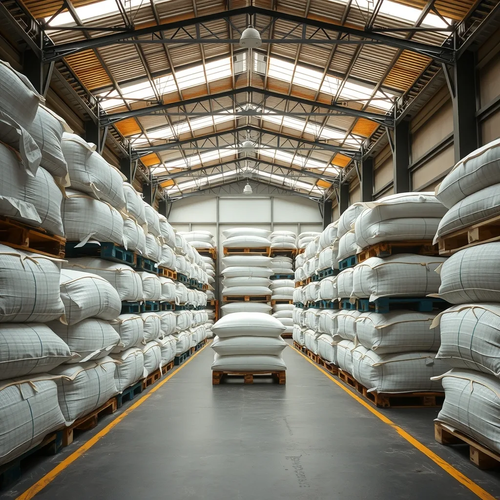
- 25 kg or 50 kg PP woven bags with sealed PE liner, or 500-1,000 kg FIBC. Moisture barrier is not optional on a hygroscopic oxidiser.
- UV-stabilised FIBC fabric if the product will be stored outdoors at destination.
- Class 5.1 labelling, UN number, proper shipping name and placarding as the applicable transport regulation requires.
- Container preparation: clean, dry, free of any hydrocarbon or organic residue. A container that previously carried oil or an organic cargo is not acceptable – specify and verify this.
- Mark with product name, N percentage, net weight, lot number, production date, origin, producer code, storage and segregation instructions, and all destination regulatory information.
- Include the safety and storage information in the destination language on the bag, not only in the documents.
MOQ, Lead Time & Incoterms
MOQ follows container economics – roughly 25-27 tonnes bagged in a 20’ container – but in practice the binding constraint is licensing, not tonnage. There is little point discussing quantity before the import permit path is established.
Lead time for production is typically 3-6 weeks. The real timeline is the regulatory one: import licensing, end-user documentation and destination product registration frequently run to several months, and they are the critical path in essentially every first order in this category. Anyone promising a fast first shipment of ammonium nitrate is either skipping something or has not understood your destination.
Incoterms: FOB Bandar Abbas or EXW for overland routes. Confirm the transport classification before requesting a freight quotation, and confirm the carrier will accept Class 5.1 on your route – some will not, and some ports restrict it.
Price & Total Cost of Ownership
- Compare on cost per unit of nitrogen delivered, landed – and include the compliance cost, which is material in this product and negligible in most others.
- Ammonia and natural gas prices drive the underlying cost.
- Freight is more expensive than the tonnage suggests because of the dangerous-goods classification, restricted stowage and limited carrier options.
- Compliance costs – licensing, testing, certification, documentation – are substantial, largely one-off, and hurt disproportionately on a small first order.
- CAN versus AN: run the comparison properly. CAN’s freight penalty is often outweighed by lower regulatory cost, easier carriage and reduced liability exposure.
The expensive failures here are not commercial, they are regulatory: a shipment that cannot clear because licensing was incomplete, or a product that fails detonation resistance documentation at the border. Both are entirely avoidable with front-loaded paperwork.
How IranLocalize Reduces Your Risk
- End-user and licensing verification first. We establish that the transaction is legitimate and licensable before we quote. This protects you as much as anyone.
- Producer verification. We visit the plant and confirm it manufactures, with the conditioning and coating steps actually installed.
- Specification drafting – N, moisture, coating, granule size, crush strength, thermal-cycling conditioning, oil retention, organics, chlorides, heavy metals.
- Independent laboratory testing on the shipped lot, plus verification of detonation-resistance documentation where required.
- Transport classification confirmed in writing for your exact product and route, with carrier and port acceptance checked before booking.
- Container verification – clean, dry and free of hydrocarbon residue.
- Regulatory coordination on import licensing, destination registration and SDS.
- Contracting with hard specs, certification requirements, inspection rights and penalties.
- Pre-shipment inspection – bag condition and seal, moisture, granule condition, labelling and placarding, container condition, loading supervision.
- A straight no where required. If the licensing cannot be satisfied, we will tell you rather than look for a way around it.
RFQ Checklist – Send This to Get a Precise Quote
- Product – AN or CAN, and the nitrogen percentage required.
- Destination country, and your import licence status – this comes before everything else.
- Your end use and end-customer profile – agricultural distribution, direct farm use, or industrial.
- Quantity and packaging: 25 kg, 50 kg, FIBC.
- Whether the product will be bulk blended, and with what.
- Granule size required.
- Maximum moisture and coating requirement.
- Detonation resistance certification required yes/no.
- Heavy metal and contaminant limits for your destination.
- Destination port or border crossing, and whether Class 5.1 is accepted there.
- Incoterm and target shipment window.
- Your destination product registration status.
Buyer Mistakes and How to Avoid Them
- Treating licensing as paperwork to sort out later. It is the critical path and often takes months. Fix: start it before the first price discussion.
- Assuming the freight quotation is like any other fertiliser. Fix: confirm the classification and carrier and port acceptance first.
- Ignoring thermal cycling. A product that crosses 32°C repeatedly degrades to powder. Fix: require thermal-cycling conditioning and a granule-integrity specification.
- Under-specifying moisture and coating. Fix: sealed liner, low moisture verified at loading, specified coating.
- Accepting a container with hydrocarbon residue. Fix: specify and verify container cleanliness.
- Supplying a channel that cannot store it safely. Fix: decline. Segregation from combustibles is not negotiable.
- Buying AN where CAN would do. Fix: run the comparison including regulatory cost and liability.
- Relying on a generic annual test certificate. Fix: require documentation on the shipped lot.
FAQs
Should I buy AN or CAN? For most agricultural buyers, CAN. It is easier to license, safer to store, easier to ship, non-acidifying, and adds calcium. AN makes sense where the higher nitrogen concentration genuinely justifies the additional regulatory burden.
What is the 16% nitrogen threshold? Under EU Regulation (EU) 2019/1148, ammonium nitrate at or above 16% nitrogen by weight in relation to ammonium nitrate is a restricted explosives precursor – not available to the general public, restricted to professional users and economic operators, with supply-chain verification and suspicious-transaction reporting obligations. Most other jurisdictions have equivalent controls.
Why does the 32°C phase transition matter? Ammonium nitrate changes crystal form near that temperature. A granule crossing it repeatedly – normal in a container or in outdoor storage – expands and contracts internally and can break down into powder. Thermal-cycling conditioning during manufacture is what prevents this.
How long does a first order really take? Production is weeks. Licensing and registration are usually months. Budget on the regulatory timeline, not the production one.
Will you supply anyone who pays? No. We verify the end user and the licensing position before quoting, and we decline where they cannot be satisfied.
Is it a dangerous good? Yes – typically Class 5.1 oxidiser. This affects packaging, documentation, stowage, carrier selection and port acceptance. Confirm the exact classification for your product and route.
Can it be bulk blended? Yes, but blending ammonium nitrate carries its own compatibility rules – some combinations are unsafe or cause rapid degradation. Tell us what you intend to blend it with and we will check compatibility before you order.
Collaboration Workflow with IranLocalize
- Send your enquiry with destination, end use and licensing status. We assess licensability before quoting.
- End-user verification and destination regulatory review.
- We shortlist verified producers and return technical and commercial proposals.
- Sample approval from current production, with retained samples.
- Independent testing plus verification of detonation-resistance and conditioning documentation.
- Transport classification confirmed, carrier and port acceptance checked.
- Contract with hard specs, certification requirements, inspection rights and penalties.
- Production and pre-shipment inspection, including labelling, placarding and container condition.
- Shipping and documentation with full dangerous-goods handling.
Executive Summary
- Why Iran: a fully domestic gas-to-ammonia-to-nitric-acid-to-nitrate chain, with short overland freight to large regional agricultural markets.
- What actually matters: licensing and end-user documentation first; then thermal-cycling conditioning, moisture, coating and granule integrity; then the nitrogen figure.
- Where buyers lose money: treating licensing as an afterthought, and discovering the Class 5.1 freight and port constraints after agreeing a price.
- Why IranLocalize: we verify licensability before quoting, confirm classification before booking, test on the shipped lot – and we decline business we cannot do properly.
Considering ammonium nitrate or CAN? Tell us your destination, end use and licensing position. We will tell you honestly whether it is workable, whether CAN is the better product for you, and what the realistic timeline is.