

Key Products
Bell Pepper from Iran
Why Source Bell Pepper from Iran?
Iran is a genuine volume player in global bell pepper (capsicum) trade – exporting well over 185,000 tonnes a year, with production concentrated in large, modern hydroponic greenhouse zones, most notably a roughly 2,400-hectare greenhouse cluster around Isfahan (particularly Tiran and Karvan). That scale of protected, greenhouse-based cultivation is what makes Iranian bell pepper different from field-grown competitors: greenhouse production runs close to year-round (around 10 months annually), giving buyers consistent maturity, color uniformity, and export-ready quality rather than a short field-harvest window.
Established markets already trust this supply – Russia, the UAE, Iraq, Qatar, Kuwait, and Oman are established, repeat destinations for Iranian bell pepper. If you’re comparing origins purely on price, several regions compete. If you need reliable color grading, greenhouse-consistent quality, and cold-chain-aware shipping handled correctly, that’s where a verified Iranian grower/packer and disciplined export logistics earn their keep. IranLocalize exists to make that sourcing simple for a foreign buyer: verified greenhouse suppliers, clear grade and color specs, and shipment-level quality control.
Product Overview & Use Cases
Bell pepper (sweet pepper / capsicum) grown in Iran’s greenhouse belt serves several B2B buyer segments:
- Fresh produce importers and wholesalers – bulk supply for onward distribution
- Retail chains and supermarkets – premium-grade, color-uniform peppers for shelf display
- Foodservice and food processing – commercial-grade volume for restaurants, catering, and processed-food inputs
Colors, Grades & Specifications
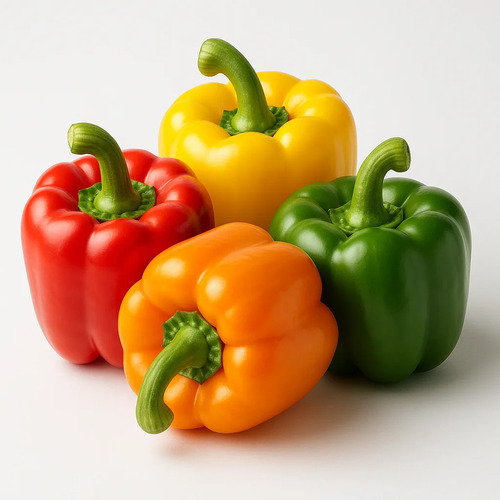
- Colors: red, yellow, orange, and green – Iranian greenhouse production covers the full multi-color range buyers expect for retail and foodservice presentation, not just the green/unripe fruit.
- Grading: commercial (bulk) grade for wholesale and foodservice buyers who prioritize volume and price; premium grade for supermarkets and specialty retailers needing uniform size, thick smooth walls, and superior shelf life – specify which grade your buyer segment actually needs rather than defaulting to premium and paying for a spec you don’t require.
- Size classes: small, medium, large, and extra-large/jumbo, based on fruit diameter – extra-large and jumbo peppers with thick, smooth walls command the strongest market price and are typically reserved for premium retail.
- Quality markers: well-formed, firm fruit with thick flesh; color uniformity and minimal external defects are the main visual quality checkpoints, especially for premium-grade buyers.
Quality, Compliance & Testing
- Firmness & wall thickness: checked against the target grade – thin-walled or soft fruit doesn’t hold up through cold-chain transit.
- Color uniformity: especially important for premium/retail-grade orders where shelf appearance matters as much as taste.
- Cold-chain integrity: bell pepper is perishable – verified reefer container capability and correct pre-cooling before loading are essential, not optional, for any shipment beyond short regional distances.
- Phytosanitary certificate: standard requirement for fresh produce export – confirmed and arranged as part of the export documentation for every shipment.
Packaging & Marking
- Ventilated corrugated cartons: the standard export format, with vent holes for airflow during cold transport.
- Stackable plastic crates: an alternative for buyers/routes where reusable crates suit the distribution chain better than cartons.
- Carton weight: commonly in the 20-25 kg range for bulk/commercial-grade export cartons – confirm your preferred carton weight and count-per-carton against your destination market’s handling norms.
- Carton marks: grade, color, size class, net/gross weight, packing date, batch/lot, Made in Iran.
MOQ, Lead Time & Incoterms
- MOQ and shipment method: air freight is common for smaller, time-sensitive orders but carries a real practical ceiling – around 5 tonnes per shipment is a typical air freight limit; sea/land shipment in refrigerated containers is the standard route for larger volume, with a single reefer container commonly carrying around 14 tonnes.
- Lead time: greenhouse production year-round (~10 months annually) means lead time is driven mainly by packing/consolidation and logistics booking, not seasonal availability, unlike field-grown competitors.
- Incoterms: FOB Bandar Abbas or other applicable Iranian port for sea freight; overland routes available for buyers in Russia, Iraq, and neighboring markets; air freight quoted separately given its lower tonnage ceiling and higher cost.
- Payments: Wire transfer (T/T) standard; L/C available case-by-case for larger volume commitments.
Coaching, not comfort: don’t assume a single greenhouse can reliably supply a full reefer container’s worth (around 14 tonnes) of uniform-grade product on your timeline – sourcing across a shortlist of verified growers, with sorting/packing capacity actually matched to your order size, avoids the quality drift that comes from squeezing one supplier past their real capacity.
Price & TCO Considerations
- Price scales with grade, size class, and color: extra-large/jumbo, color-uniform, premium-grade fruit commands a real premium over commercial-grade bulk – comparing quotes only makes sense once grade and size class are matched.
- Real cost comparison: landed cost should weigh verified cold-chain handling and grade consistency against FOB price alone – a cheaper lot that arrives with heat damage or inconsistent color grading is a false saving on a perishable product.
- Supply risk: verified greenhouse growers with real packing-house capacity and cold-chain discipline remove the most common source of dispute in fresh produce trade – quality degradation in transit.
How IranLocalize Reduces Your Risk
IranLocalize operates as your sourcing, verification, and QC arm on the ground in Iran:
- Grower/packer screening: greenhouse capacity, grading/sorting capability, export track record, cold-chain infrastructure.
- Pre-order sampling: physical samples verified against your target grade, color, and size class before committing to volume.
- Negotiation & contracting: hard specs (grade, color, size class, packaging), Incoterms, and delivery terms in writing.
- Pre-shipment inspection (PSI): firmness, color, and size checks; cold-chain and pre-cooling verification before loading.
- Logistics & documentation: reefer container/air freight booking, phytosanitary certificate, and export documentation aligned to your destination market.
- Single point of contact: one project manager on WhatsApp/email throughout.
RFQ Checklist (Send This to Get a Precise Quote)
- Grade: commercial/bulk or premium
- Color(s): red, yellow, orange, green, or a specified mix
- Size class: small, medium, large, or extra-large/jumbo
- Packaging: ventilated cartons (specify target carton weight) or stackable crates
- Quantity: total volume + one-off or recurring cadence
- Shipment method: air (time-sensitive, lower tonnage) or sea/land reefer (higher volume)
- Destination + Incoterms: FOB/CIF with port or border crossing for freight calculation
- Target lead time: delivery window needed
Buyer Mistakes (and How to Avoid Them)
- “Expecting one greenhouse to fill a full container.” Result: inconsistent grade/color across the shipment because one supplier was pushed past their real capacity. Fix: source across a shortlist of verified growers matched to your actual order size.
- “No cold-chain verification before loading.” Result: heat damage or quality loss in transit on a genuinely perishable product. Fix: confirm pre-cooling and reefer container booking as part of supplier screening, not an afterthought.
- “Ordering premium grade without needing it.” Result: paying a real price premium for uniform size/appearance a foodservice or processing buyer didn’t actually need. Fix: match grade to your actual buyer segment – commercial grade for wholesale/foodservice, premium for retail shelf display.
- “Choosing air freight by default.” Result: paying a significant premium and hitting a low tonnage ceiling (around 5 tonnes) when sea/land reefer would have covered the volume more cost-effectively. Fix: reserve air freight for genuinely time-sensitive or smaller orders; plan sea/land reefer shipment for standard volume.
FAQs
What colors of bell pepper does Iran export? Red, yellow, orange, and green – Iran’s greenhouse production covers the full color range retail and foodservice buyers typically need, not just green fruit.
Is Iranian bell pepper available year-round? Yes – greenhouse cultivation runs roughly 10 months of the year, giving buyers much more consistent availability than field-grown competitors tied to a seasonal harvest window.
What’s the difference between commercial and premium grade? Commercial (bulk) grade suits wholesale and foodservice buyers focused on volume and price; premium grade is hand-selected for size uniformity, wall thickness, and shelf life, aimed at supermarkets and specialty retail.
How is bell pepper shipped to keep it fresh? Refrigerated (reefer) containers for sea/land routes, with proper pre-cooling before loading; air freight is used for smaller, time-sensitive orders but has a lower practical tonnage limit (around 5 tonnes per shipment).
What documentation is required for export? A phytosanitary certificate is standard for fresh produce export, alongside standard commercial export documentation – we confirm and arrange this as part of the sourcing process.
Can orders recur on a schedule? Yes – given near year-round greenhouse availability, we can set up a reorder cadence and safety stock once the first order and QC process are validated.
Collaboration Workflow with IranLocalize
- Send RFQ using the checklist above.
- Grower/packer shortlist (2-3 verified greenhouse suppliers matched to your grade, color, and volume needs).
- Sample approval – physical samples verified against grade, color, and size class.
- Contract – hard specs, Incoterms, and delivery terms in writing.
- Production & pre-shipment inspection – firmness, color, size, and cold-chain verification before loading.
- Shipping & documents – reefer/air logistics and phytosanitary documentation aligned to your destination market.
- After-sales – reorder planning for recurring volume, leveraging near year-round greenhouse supply.
Executive Summary
- Why Iran: genuine export scale (185,000+ tonnes/year) backed by modern, near-year-round greenhouse production concentrated around Isfahan.
- What matters: grade, color, and size class matched to your actual buyer segment, plus verified cold-chain handling – not FOB price alone.
- Why IranLocalize: unbiased grower/packer verification, precise grade specs, a negotiator on your side, and rigorous pre-shipment inspection.
Ready to evaluate bell pepper suppliers in Iran? Share your RFQ. We’ll deliver verified grower options, graded samples, and firm timelines.
Building a wider Iranian fresh produce programme? See our guides to apples – including the aromatic Golab variety – and onions from Iran.