
Key Products
Onions from Iran
Why Source Onions from Iran?
Iran is a genuine top-tier player in global onion trade – alongside India and China, it ranks among the world’s largest onion producers, growing over 2 million tonnes a year. Production is spread across several major growing provinces – Khuzestan, Fars, Kerman, East Azerbaijan, and Zanjan – with favorable climate across these regions supporting near year-round harvesting rather than a single narrow season, which gives buyers more consistent supply than a single-region origin typically offers.
Iranian onions already move into established export markets across the Middle East, Europe, and Asia, at genuinely competitive FOB pricing. If you’re buying purely on spot price, several origins compete on this commodity. If you need consistent size grading, verified skin quality, and a supplier who loads containers correctly and on schedule, that’s where a verified Iranian grower/packer and disciplined export logistics earn their keep. IranLocalize exists to make that sourcing simple for a foreign buyer: verified growers and packing houses, clear grade specs, and shipment-level quality control.
Product Overview & Use Cases
- Fresh produce importers & wholesalers – bulk supply for onward distribution to retail and foodservice.
- Retail chains and supermarkets – graded, consistent-size onions for shelf display.
- Food processing & foodservice – volume supply for restaurants, catering, and processed-food inputs where consistent quality matters more than retail presentation.
Varieties & Grading
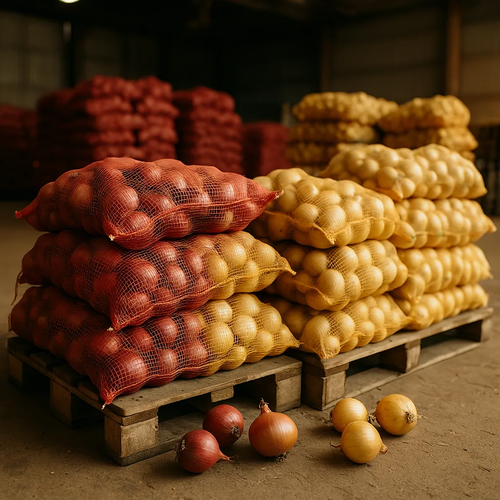
- Colors/varieties: red, yellow (golden), and white onions are all produced at export scale in Iran – confirm which variety your destination market and end use actually calls for, since preference varies significantly by region.
- Size grading: commonly graded in the 40-80mm diameter range – confirm your target size band against your buyer segment (smaller sizes for some food-processing uses, larger for retail-facing bulk).
- Quality grading factors: skin quality (tight, dry, unbroken skin), firmness, and absence of mold, decay, or sprouting are the core visual/quality checkpoints beyond size alone.
Buyer’s-perspective note: size grading alone doesn’t guarantee quality – a batch can be correctly sized but still have inconsistent skin quality or hidden decay if sorting wasn’t done carefully. Always verify both together, not size as a proxy for overall grade.
Quality, Compliance & Testing
- Size consistency verification: checked across a full shipment, not just a sample bag – inconsistent sizing is a common shortfall when packing wasn’t carefully sorted.
- Skin and firmness inspection: tight, dry skin and firm bulbs – soft spots or loose skin are early signs of decay that will worsen in transit.
- Sprouting/decay checks: especially relevant depending on harvest timing and storage duration before shipment.
- Phytosanitary certificate: standard requirement for fresh produce export – confirmed and arranged as part of the export documentation for every shipment.
Packaging & Marking
- Mesh bags: the standard export format for fresh onions, typically in 10kg, 20kg, or 25kg bag sizes – allows airflow, which matters for a stored bulb crop.
- Food-grade polypropylene (PP) or burlap: standard bag materials certified for direct contact with agricultural produce.
- Carton/bag marks: variety, size grade, net weight, packing date, batch/lot, Made in Iran.
MOQ, Lead Time & Incoterms
- MOQ: most exporters work from a minimum of one 20-foot container, typically holding 25-30 tonnes – this is the practical baseline for container-efficient shipping on this commodity.
- Lead time: near year-round harvesting across Iran’s multiple growing regions means lead time is driven mainly by packing/consolidation and logistics booking rather than a narrow seasonal availability window.
- Incoterms: FOB Bandar Abbas most common for sea freight; overland routes available for buyers in Iraq and neighboring markets given Iran’s established export routes there.
- Payments: Wire transfer (T/T) standard; L/C available case-by-case for larger volume commitments.
Coaching, not comfort: an onion quote that’s notably below the market range (roughly $180-250/tonne FOB as a general reference, though this shifts with season, variety, and volume) is worth checking against actual size/grade specs before committing – grade and sorting quality are exactly where cost gets cut when price is negotiated in isolation from spec.
Price & TCO Considerations
- Price scales with size grade, variety, and season: larger, more uniform sizing and off-peak timing both command a premium over baseline market pricing.
- Real cost comparison: landed cost should weigh verified grade consistency and phytosanitary compliance against FOB price alone – a cheaper lot with inconsistent sizing or hidden decay costs more in sorting/waste at destination than the unit price difference saves.
- Supply risk: verified growers/packers with real sorting discipline remove the most common source of dispute in bulk onion trade – size inconsistency and decay discovered only after the container arrives.
How IranLocalize Reduces Your Risk
IranLocalize operates as your sourcing, verification, and QC arm on the ground in Iran:
- Grower/packer screening: production capacity across growing regions, sorting/grading capability, export track record.
- Pre-order sampling: physical samples verified against your target size grade and variety before committing to volume.
- Negotiation & contracting: hard specs (variety, size grade, packaging), Incoterms, and delivery terms in writing.
- Pre-shipment inspection (PSI): size, skin quality, and firmness checks; container loading oversight.
- Logistics & documentation: export docs, phytosanitary certificate, and container/overland loading oversight.
- Single point of contact: one project manager on WhatsApp/email throughout.
RFQ Checklist (Send This to Get a Precise Quote)
- Variety: red, yellow, or white
- Size grade: target diameter range within 40-80mm
- Packaging: bag size (10kg/20kg/25kg) and material
- Quantity: container quantity (25-30 tonnes per 20’ container) + one-off or recurring cadence
- Destination + Incoterms: FOB/CIF with port or border crossing for freight calculation
- Target lead time: delivery window needed
Buyer Mistakes (and How to Avoid Them)
- “Treating size grade as the whole quality picture.” Result: correctly-sized onions that still have inconsistent skin quality or hidden decay. Fix: verify skin quality and firmness alongside size, not size alone.
- “Price-only comparison without confirming grade specs.” Result: a cheaper quote that turns out to be a lower size/quality grade than expected. Fix: compare quotes only after confirming exact size range and quality grade, not price alone.
- “No phytosanitary certificate confirmation upfront.” Result: a shipment held at destination customs over missing documentation. Fix: confirm certificate arrangements before finalizing the order, not after shipping.
FAQs
What onion varieties does Iran export? Red, yellow (golden), and white onions are all produced at export scale – tell us your destination market and we’ll confirm which variety is the standard preference there.
What size grading is available? Commonly 40-80mm diameter – confirm your target size band based on whether you need onions for retail display or food processing.
Is Iranian onion available year-round? Near year-round, given multiple growing regions with different harvest timing across Khuzestan, Fars, Kerman, East Azerbaijan, and Zanjan – though pricing and exact availability shift with season.
What’s the typical MOQ? Most exporters work from a minimum of one 20-foot container, typically 25-30 tonnes.
What packaging is standard? Mesh bags in 10kg, 20kg, or 25kg sizes, made from food-grade polypropylene or burlap.
Can orders recur on a schedule? Yes – given the near year-round supply across multiple regions, we can set up a reorder cadence once the first order and QC process are validated.
Collaboration Workflow with IranLocalize
- Send RFQ using the checklist above.
- Grower/packer shortlist (2-3 verified options matched to your variety, grade, and volume needs).
- Sample approval – physical samples verified against size grade and quality.
- Contract – hard specs, Incoterms, and delivery terms in writing.
- Production & pre-shipment inspection – size, skin quality, and loading verification.
- Shipping & documents – phytosanitary certificate and export documentation aligned to your destination market.
- After-sales – reorder planning for recurring volume.
Executive Summary
- Why Iran: genuine top-tier global production scale (2+ million tonnes/year) across multiple growing regions, giving near year-round supply.
- What matters: verified size grade and skin/firmness quality together – not size or price alone.
- Why IranLocalize: unbiased grower/packer verification, precise grade specs, a negotiator on your side, and rigorous pre-shipment inspection.
Ready to evaluate onion suppliers in Iran? Share your RFQ. We’ll deliver verified grower options, graded samples, and firm timelines.
Building a wider Iranian fresh produce programme? See our guides to apples – including the aromatic Golab variety – and bell peppers from Iran.