

Key Products
Diesel Exhaust Fluid (DEF / AUS 32) from Iran: Sourcing Urea Solution to ISO 22241
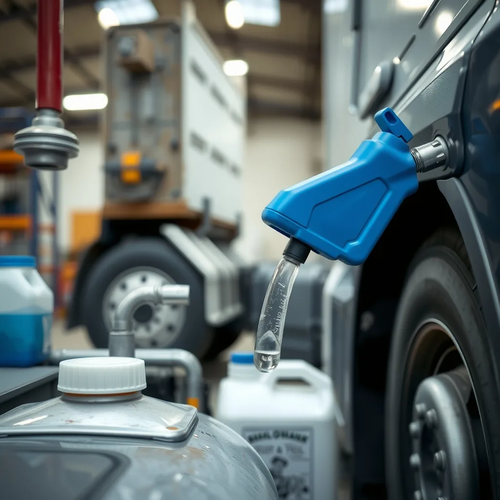
A Note on the Name
This product is sold under several names. AUS 32 (Aqueous Urea Solution 32.5%) is the technical designation in ISO 22241. DEF (Diesel Exhaust Fluid) is the common term in North America and much of Asia. AdBlue® is a registered trademark of the VDA, the German automotive industry association, and using that name on a product requires a VDA licence.
That last point is a commercial trap worth stating plainly: you cannot lawfully label or market product as “AdBlue” without the VDA licence, regardless of whether it meets ISO 22241. Compliant product that is not licensed must be sold as DEF or AUS 32. If a supplier offers to print “AdBlue” on your drums without evidence of licensing, that is a trademark problem you would be importing along with the fluid.
It is also not a fertiliser, despite being made from urea. It goes into a vehicle’s exhaust aftertreatment system, not onto a field, and the purity requirements are an order of magnitude stricter than any fertiliser grade.
Why Source DEF from Iran?
The structural case is strong and simple: DEF is 32.5% urea and 67.5% water, and Iran is one of the world’s largest urea producers and exporters. National urea capacity runs to roughly nine million tonnes a year with around half of it exported, from some of the largest single urea plants anywhere. The feedstock is domestic, abundant, gas-based and competitively priced.
Add short overland freight to Iraq, Turkey, Afghanistan, the Caucasus and Central Asia – markets where Euro IV, V and VI diesel fleets are growing and DEF demand with them – and the commercial logic is real.
But the feedstock is where the logic stops, and this is the whole substance of this page:
Having abundant urea is not the same as being able to make DEF. Fertiliser-grade urea is categorically unsuitable. DEF requires technical or automotive-grade urea with impurity limits far below fertiliser specification, blended with deionised water, in a dedicated clean facility.
A supplier who treats DEF as “urea dissolved in water” will destroy your customers’ SCR catalysts and injectors. An SCR system is an expensive component, and the damage from contaminated fluid is not a warranty argument you win.
Iran’s genuine fertiliser strengths are a separate conversation – see our guides to ammonium sulphate and potassium sulphate.
What ISO 22241 Actually Demands
The standard is not a formality. It exists because the SCR catalyst is intolerant of contamination, and the limits are at parts-per-million levels.
Composition
- Urea content: 31.8-33.2% by mass (nominally 32.5%, the eutectic concentration that gives the lowest freezing point).
- Balance: deionised water. Not softened, not filtered tap water – deionised.
Impurity limits – the part that separates a real producer from a blender
- Biuret – a urea condensation product formed by overheating during manufacture, and the single most telling indicator of urea grade. Fertiliser urea routinely carries far more biuret than DEF permits.
- Aldehydes, at low single-digit mg/kg.
- Insolubles, at very low levels, with filtration to match.
- Phosphate.
- Metals – calcium, iron, copper, zinc, chromium, nickel, aluminium, magnesium, sodium, potassium – each capped at a fraction of a mg/kg. These are catalyst poisons. This is why deionised water is not optional and why the storage and transfer equipment matters as much as the fluid.
- Alkalinity as ammonia.
- Refractive index and density at reference temperature – the quick field checks.
Confirm the current numerical limits against the applicable part of ISO 22241 for your market rather than working from a supplier’s summary table, and require a full certificate of analysis against every parameter, not a selective one. A CoA listing urea content and density alone is not a conformity document.
Materials, Storage and the Contamination Problem
DEF is mildly corrosive and extremely easy to spoil. This is where most DEF supply businesses actually fail.
- Compatible materials only: stainless steel of the appropriate grades, high-density polyethylene, polypropylene. Carbon steel, galvanised steel, copper, brass, zinc, aluminium and solder are not compatible and will contaminate the fluid with exactly the metals the standard caps.
- Dedicated equipment throughout – tanks, pumps, hoses, nozzles, meters, totes. Equipment that has carried diesel, oil, coolant, water treatment chemicals or any other fluid is not acceptable. Cross-contamination with diesel is especially damaging.
- Temperature. DEF freezes around -11°C, expanding as it does; freezing and thawing does not in itself ruin properly made fluid, but tanks and packaging must tolerate the expansion. At the other end, prolonged heat degrades urea and raises ammonia, so shelf life is a function of storage temperature. Specify a storage temperature regime and state a realistic shelf life against it – commonly around 12-18 months at moderate temperatures, markedly less if stored hot. A container crossing the Gulf in summer is a heat exposure event, and it must be planned for.
- Light and air. Keep sealed; avoid prolonged open storage.
- Water quality at every stage. If a drum is topped up with tap water anywhere in the chain, the product is finished.
Packaging
- 10 L and 20 L HDPE jerrycans with tamper-evident closures for retail and fleet use; a pouring spout or misfuelling-resistant neck is worth specifying.
- 200 L HDPE drums and 1,000 L IBCs for workshops and fleets.
- Bulk road tanker and flexitank for large consumers, where dedicated equipment is assured.
- All packaging must be new and DEF-dedicated. Reconditioned drums are a contamination risk in this product in a way they are not in most.
- Batch number, production date, expiry, and the full ISO 22241 conformity statement on every pack, plus handling and storage instructions in the destination language.
- Do not print “AdBlue” without the licence. Label it DEF or AUS 32.
Compliance & Certification
- ISO 22241 conformity – the core requirement, with the full CoA.
- Production facility standards. Ask whether production runs under a recognised quality system and whether the line is dedicated to DEF. A line shared with other chemistry is a contamination question you must resolve before ordering.
- VDA licensing if and only if AdBlue branding is intended. Confirm the licence exists; do not take it on trust.
- Destination requirements. Many markets have their own approval, registration or labelling rules for DEF, and some fuel-quality regimes cover it. Check before ordering.
- SDS in GHS format in the destination language. DEF is generally not classified as a dangerous good for transport, which simplifies freight considerably – confirm for your route.
- Sanctions and banking must be settled for your jurisdiction before you commit. We will tell you plainly what is workable.
MOQ, Lead Time & Incoterms
MOQ follows packaging and container economics. A 20’ container holds roughly 20-22 tonnes of packed fluid; IBC and bulk loads scale from there. Private-label jerrycan programmes carry higher minimums because of label and mould commitments.
Lead time typically runs 3-6 weeks, driven by technical-grade urea availability and packaging procurement rather than by blending, which is fast. Private-label artwork and tooling add to the front end.
Incoterms: FOB Bandar Abbas for sea freight; EXW is often the right answer for overland movement to Iraq, Turkey, Afghanistan, Armenia, Azerbaijan and Central Asia – which is where the freight economics of shipping a product that is two-thirds water actually work. CFR/CIF available.
Be realistic about freight, because it is the commercial crux: DEF is 67.5% deionised water. Shipping it long distances means paying freight to move water. For distant markets the economically sound structure is usually to buy technical-grade urea and blend locally, which is a service we can also arrange. We will run that comparison with you rather than sell you a container of water.
Price & Total Cost of Ownership
- Technical-grade urea price is the dominant input and tracks the global urea market.
- Grade matters more than volume. The gap between fertiliser and technical urea is the gap between a product and a liability.
- Packaging is a large share of landed cost on small formats – jerrycans, closures and labels can rival the fluid’s value.
- Freight on water, as above.
- Testing – a full ISO 22241 panel on each batch is a real cost and a non-negotiable one.
The expensive failures are unambiguous here: fluid made from fertiliser-grade urea, contamination from non-dedicated equipment, and heat-degraded product arriving out of specification. Each can damage a customer’s vehicle fleet, and in this product the reputational consequence travels faster than the commercial one.
How IranLocalize Reduces Your Risk
- Producer verification. We visit, confirm the facility blends DEF on dedicated equipment with deionised water, and establish whether it produces or merely packs.
- Urea grade verification – the central check. We confirm the urea feedstock is technical/automotive grade and obtain its specification, because this is where corners get cut invisibly.
- Specification drafting against the full ISO 22241 parameter set, not a summary.
- Independent laboratory testing on the production batch across every parameter including biuret, aldehydes, insolubles and the full metals panel.
- Equipment and material audit – tanks, lines, pumps and packaging materials checked for compatibility and dedication.
- Packaging and shelf-life design – new DEF-dedicated packaging, heat exposure planned for the route, realistic shelf life stated against a storage regime.
- Trademark guidance – we will not let you print a name you are not licensed to use.
- Contracting with hard specs, retained samples, inspection rights and rejection rights.
- Pre-shipment inspection – packaging integrity and seals, batch and expiry marking, sampling for retained analysis, container condition and loading supervision.
- A straight answer on freight. If blending locally from Iranian technical urea beats shipping finished fluid to your market, we will say so.
RFQ Checklist – Send This to Get a Precise Quote
- Product – finished DEF / AUS 32, or technical-grade urea for local blending.
- Quantity and packaging – 10 L, 20 L, 200 L drum, IBC, or bulk.
- Destination country – determines approvals, labelling and freight economics.
- Whether AdBlue branding is intended, and whether you hold a VDA licence.
- Private label yes/no, and who supplies artwork.
- Required shelf life and the storage temperatures it will actually see.
- Confirmation that full ISO 22241 testing is required on each batch.
- Your storage and dispensing equipment – so we can confirm material compatibility at your end.
- Incoterm, destination port or border crossing, and target shipment window.
- Destination registration or approval status, and who is handling it.
Buyer Mistakes and How to Avoid Them
- Assuming urea is urea. Fertiliser grade will poison an SCR catalyst. Fix: verify the feedstock is technical/automotive grade and get its specification.
- Accepting a partial CoA. Fix: require every ISO 22241 parameter, including biuret, aldehydes, insolubles and all metals.
- Using non-dedicated tanks, hoses or drums. Fix: dedicated DEF equipment and compatible materials only, end to end.
- Topping up with tap water. Fix: deionised water only, and control it at every point in your chain.
- Ignoring heat. Fix: plan the route’s temperature exposure and state shelf life against a storage regime.
- Printing “AdBlue” without a licence. Fix: label it DEF or AUS 32 unless you hold the VDA licence.
- Shipping finished fluid across an ocean. Fix: run the maths on local blending from technical urea first.
- Reusing reconditioned drums. Fix: new DEF-dedicated packaging.
FAQs
Is DEF a fertiliser? No. It is made from urea, but it is an automotive emissions-control fluid injected into the exhaust stream. The purity requirements are far stricter than any fertiliser grade and the two are not interchangeable in either direction.
Can I make DEF from Iranian fertiliser urea? No. Biuret, aldehydes, insolubles and metals in fertiliser urea are well above ISO 22241 limits and will damage SCR catalysts and injectors. Technical or automotive-grade urea is required.
What is the difference between AdBlue, DEF and AUS 32? They describe the same fluid. AUS 32 is the ISO 22241 designation, DEF the common name in North America and Asia, and AdBlue a VDA registered trademark that requires a licence to use.
Does it freeze? Around -11°C, and it expands on freezing, so packaging and tanks must accommodate that. Properly made fluid that has frozen and thawed is generally still in specification, but the containers must survive it.
How long does it keep? Commonly around 12-18 months at moderate storage temperatures, and materially less if stored hot. State the storage regime alongside any shelf-life claim.
Should I import finished fluid or blend locally? If you are in a neighbouring market with short overland freight, finished fluid is usually fine. If you are further away, importing technical-grade urea and blending locally with deionised water is generally better economics, since finished DEF is two-thirds water.
What is a realistic first order? One container of a single pack format, with full independent ISO 22241 testing on the batch and a verified urea feedstock specification, before committing to a programme.
Collaboration Workflow with IranLocalize
- Send your RFQ with destination, format, volume and intended branding.
- We assess the freight case – finished fluid or technical urea for local blending – and tell you which serves you better.
- We shortlist verified producers, stating clearly who blends on dedicated equipment and who merely packs.
- Feedstock verification – technical-grade urea specification obtained and checked.
- Sample supply from a production batch, with retained samples on both sides.
- Independent testing across the full ISO 22241 parameter set.
- Packaging and labelling review, including trademark position.
- Contract with hard specs, batch testing requirements, retained samples, inspection and rejection rights.
- Production and pre-shipment inspection – seals, batch and expiry marking, container condition, loading supervision.
- Post-delivery review – your incoming QC feeds into the next batch’s specification.
Executive Summary
- Why Iran: one of the world’s largest urea industries supplying the feedstock domestically, plus short overland freight to growing Euro IV-VI diesel fleets in neighbouring markets.
- The decisive point: abundant urea is not the same as DEF capability. Technical-grade urea and deionised water on dedicated equipment is the product; fertiliser urea in water is a liability that damages SCR systems.
- What actually matters: the full ISO 22241 panel – biuret, aldehydes, insolubles and metals – material compatibility end to end, and heat exposure on the route.
- Two traps: labelling product “AdBlue” without the VDA licence, and paying ocean freight to move a product that is two-thirds water when local blending would be cheaper.
- Why IranLocalize: we verify the urea grade and the dedication of the equipment, test the full parameter set independently, keep you clear of the trademark, and tell you honestly when blending locally beats importing finished fluid.
Ready to evaluate DEF producers in Iran? Tell us your destination, pack format, volume and whether you intend to brand it. We will come back with verified producers, fully tested batch samples, and an honest comparison against importing technical urea and blending at your end.