

Key Products
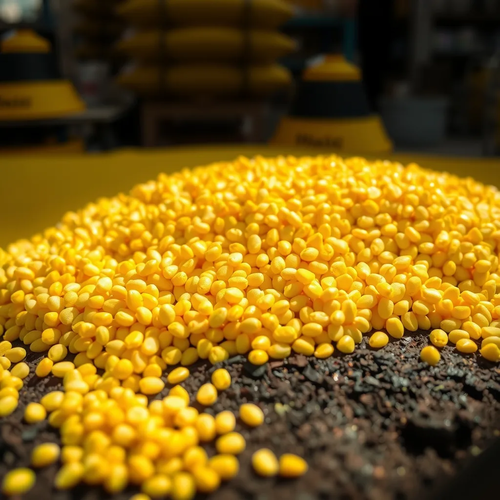
Sulphur Bentonite 90% from Iran: Degradable Sulphur Fertiliser Pastilles
Why Source Sulphur Bentonite from Iran?
This is one of the few product categories where Iran’s sourcing advantage is structural rather than incidental, and it is worth understanding why.
Sulphur bentonite is roughly 90% elemental sulphur. Iran is structurally long sulphur. Elemental sulphur is recovered as a byproduct of sweetening sour natural gas and refining sour crude – and Iran does an enormous amount of both. South Pars, the Khangiran sour gas field and the refinery network together put Iranian sulphur supply in the region of a million-plus tonnes a year. It is a byproduct that has to be sold, which puts a persistent floor under availability and a ceiling on feedstock price.
The other 10% is bentonite, and Iran has substantial domestic bentonite deposits in Semnan, Khorasan and elsewhere. So both raw materials are domestic, which is unusual: most sulphur bentonite producers worldwide import one or the other.
Add competitive energy costs for the melt-and-form process, and short overland freight to Iraq, Turkey, Afghanistan, Central Asia and the Caucasus – all significant agricultural markets with sulphur-deficient and frequently alkaline soils – and the commercial logic is straightforward.
The catch, and the thing this page exists to explain: the 90% figure that everyone quotes is the least important number in the specification. Two products can both test at 90% sulphur and behave completely differently in the field. The difference is in the bentonite, and almost nobody specifies it.
For a chloride-free potassium and sulphur source that needs no biological oxidation, see our guide to potassium sulphate (SOP) from Iran. For other Iranian bulk mineral commodities, see our guide to manganese ore from Iran.
What the Product Is and How It Actually Works
Sulphur bentonite is elemental sulphur melted and formed with roughly 10% bentonite clay into pastilles or granules, typically 2-4 mm, bright yellow, free-flowing, and suitable for spreading or blending with other fertilisers.
Understanding the agronomy is not optional here, because it determines both how you sell the product and how you should specify it.
Elemental sulphur is not plant-available. Plants take up sulphur as sulphate. Elemental sulphur must first be oxidised to sulphate by soil bacteria – principally Thiobacillus species – and that is a biological process that needs warmth and moisture and takes weeks to months.
The oxidation rate depends almost entirely on surface area. A 3 mm pastille sitting intact in soil has almost no surface area relative to its mass, and would take years to convert. This is where the bentonite earns its place:
When the pastille meets soil moisture, the bentonite swells, and the swelling pressure fractures the pastille from the inside into very fine sulphur particles – roughly 60 to 600 microns. That fragmentation multiplies the surface area by orders of magnitude, and the Thiobacillus population can then oxidise the sulphur to sulphate at an agronomically useful rate.
Three consequences follow directly, and they are the three things your customers need to be told:
- It is a slow-release product. It must be applied ahead of crop demand, not at the moment of deficiency. A grower expecting the response of ammonium sulphate or gypsum will conclude the product failed.
- It needs warm, moist soil to work. Cold or dry conditions stall the oxidation. On a cold spring soil, very little happens until the soil warms.
- If the pastille does not fragment, the product does nothing. This is the failure mode, and it is entirely a function of bentonite quality – which brings us to the specification.
Specification: What to Actually Put in the Contract
The headline numbers everyone quotes
- Elemental sulphur: 90% minimum (some grades 85-90%)
- Bentonite: approximately 10%
- Moisture: typically below 0.5%
- Particle size: 2-4 mm, with a stated percentage within range
- Appearance: bright yellow, uniform pastilles or granules, free-flowing
The numbers that actually decide whether it works
Bentonite type – the single most important and most commonly omitted specification.
Bentonite is not one material. Sodium bentonite swells dramatically in water; calcium bentonite swells far less. Since the entire disintegration mechanism depends on swelling pressure, a product made with calcium bentonite, or with poorly activated bentonite, will not fragment properly in the field – while still testing at exactly 90% sulphur and looking identical in the bag.
Specify sodium or sodium-activated bentonite, and require a swelling index or free-swell test result on the bentonite used.
Disintegration / degradation test. This is the real performance test and you should demand it: a standard test that wets the pastille and measures how completely and how quickly it breaks down. Ask for the method, the result, and a retained sample you can repeat it on. A supplier who cannot produce a disintegration result is selling you a sulphur pastille, not a sulphur fertiliser.
Crush strength and dust content. These pull in opposite directions and both matter commercially. Too weak and the product degrades into dust in bulk handling, blending and spreading – dust is unspreadable, unsaleable and a fire and explosion hazard. Too strong and it resists field disintegration. Specify a crush strength range and a maximum dust/fines percentage, measured after a handling simulation, not straight off the line.
Sulphur particle size within the pastille. The finer the sulphur dispersed in the matrix, the faster the oxidation after fragmentation. Rarely specified; worth asking about.
Heavy metals and impurities – particularly relevant for EU-destined product and for organic certification. Ask for arsenic, cadmium, lead and mercury.
Optional enriched grades. Sulphur bentonite is commonly produced with micronutrients co-formed into the pastille – zinc, boron, iron – which can be a strong differentiator in your market. Specify the micronutrient, its percentage and its form.
Compliance & Certification
- EU: the Fertilising Products Regulation (EU) 2019/1009 governs CE-marked fertilising products, with limits on contaminants including cadmium. Product placed on the EU market must meet the relevant product function category requirements, or go the national mutual-recognition route. Establish which path you are using before you order.
- REACH registration status for the substance where the EU is the destination.
- Organic certification. Elemental sulphur is permitted in most organic farming standards, which makes an organic-certified sulphur bentonite a genuinely valuable SKU. Certification must be verified at the producer with a live certificate, not claimed.
- Destination fertiliser registration. Most countries require product registration before first import – India, Brazil, Turkey, the Gulf states and most of Africa each have their own regime, and lead times can be months. Start this before you order, not after.
- Transport classification. Elemental sulphur is classified as a flammable solid (UN 1350, Class 4.1), with specific exemptions in some regulations for certain formed or coarse forms. Do not assume your product is exempt. Get the classification confirmed in writing against the applicable regulation for your mode and route, because it changes packaging, documentation, stowage and cost.
- Dust explosion hazard. Sulphur dust is genuinely explosive. This affects storage and handling at your end as much as at the producer’s, and it is another reason the dust specification matters.
- SDS in GHS format, in the destination language, prepared for the destination’s regime.
Packaging & Marking
- 25 kg or 50 kg PP woven bags, usually with a PE inner liner – moisture ingress causes premature swelling and caking in the bag.
- 1,000 kg / 1,250 kg jumbo bags (FIBC) for bulk agricultural supply, with UV-stabilised fabric if the product will sit outdoors.
- Bulk in-hold or containerised for the largest volumes, where the destination has handling capability and the transport classification permits it.
- Pallets shrink-wrapped and, for sea freight, protected against condensation – a container crossing the Gulf sweats.
- Mark with product name, sulphur and bentonite percentages, particle size range, net weight, lot number, production date, origin, producer code, and the hazard and handling information the destination requires.
Note that caked product is effectively worthless – it cannot be spread or blended. Moisture barrier and storage conditions are not a detail here.
MOQ, Lead Time & Incoterms
MOQ is set by container and production-run economics. A 20’ container of bagged product runs roughly 25-27 tonnes; most producers quote from one full container, with bulk vessel quantities available for large buyers. Micronutrient-enriched or organic-certified grades carry higher minimums because they need a dedicated production run.
Lead time typically runs 2-5 weeks for a standard 90% grade from an established producer, extending for enriched grades, private-label bagging, or where a specific bentonite has to be sourced and activated. Add separately – and start early – for destination fertiliser registration, which is frequently the real critical path and can run months.
Incoterms: FOB Bandar Abbas for sea freight; EXW is common and economically strong for overland movement to Iraq, Turkey, Afghanistan, Armenia, Azerbaijan and Central Asia. CFR/CIF is available. Confirm the transport classification early – it affects the freight quotation and the carrier’s willingness to take it.
Price & Total Cost of Ownership
- Compare on cost per unit of sulphur delivered, not cost per tonne of product – and then on cost per unit of sulphur that actually becomes available, which is where a non-disintegrating product costs you everything.
- Feedstock sulphur price is the main driver and is a global commodity that moves.
- Bentonite quality is a real cost difference. Properly activated sodium bentonite costs more than whatever is cheapest, and it is the difference between a working product and an expensive yellow gravel.
- Freight is significant on a dense, low-value-per-tonne commodity. Origin proximity to your market matters more here than in most categories – which is precisely Iran’s advantage for regional buyers.
- Registration and compliance are largely one-off and hurt most on a small first order.
The TCO framing, and the argument to make to a sceptical buyer: a product that does not fragment delivers no sulphur at all in the season it is applied. The grower pays for the product, pays for the spreading, and gets nothing. In a distribution business that is not a margin problem, it is a reputation problem – and in fertiliser distribution, reputation is the business. Pay for the bentonite and the disintegration test.
How IranLocalize Reduces Your Risk
- Producer verification. We visit the plant, confirm it melts and forms rather than re-bagging someone else’s product, and check the bentonite source and activation step.
- Specification drafting. Sulphur and bentonite percentages, bentonite type and swelling index, particle size distribution, crush strength, maximum dust, moisture, heavy metals, and a disintegration requirement with a named test method.
- Independent testing. Sulphur assay, moisture, size distribution, dust after handling simulation, and – most importantly – a disintegration test on the production lot.
- Bentonite verification at source, because this is where the corner gets cut.
- Regulatory support on destination fertiliser registration, transport classification and SDS.
- Contracting with hard specs, retained samples, inspection rights and penalties.
- Pre-shipment inspection – bag weights and condition, moisture, dust, sampling for retained analysis, container condition and loading supervision.
- Straight answers. If the transport classification or the registration timeline makes your plan unworkable, we will say so before you commit.
RFQ Checklist – Send This to Get a Precise Quote
- Grade – 90% standard, or a micronutrient-enriched grade (name the nutrient and percentage).
- Quantity and whether you want bagged or bulk.
- Destination country – this determines registration, contaminant limits and transport handling.
- Bentonite type required – sodium or sodium-activated, with a swelling index.
- Disintegration performance – the test method and result you require.
- Particle size range and the percentage that must fall within it.
- Maximum dust/fines, measured after handling simulation.
- Crush strength range.
- Heavy metal limits for your destination.
- Organic certification required yes/no.
- Packaging – 25 kg, 50 kg, FIBC or bulk; private label yes/no.
- Whether the product will be bulk blended with other fertilisers at your end – this drives the crush strength and dust specification.
- Incoterm, destination port or border crossing, and target shipment window.
- Your registration status in the destination market, and who is handling it.
Buyer Mistakes and How to Avoid Them
- Buying on the 90% figure alone. It is the easiest number to hit and the least informative. Fix: specify bentonite type and a disintegration test.
- Not specifying the bentonite. Calcium bentonite will not fragment the pastille properly. Fix: require sodium or sodium-activated bentonite with a swelling index.
- Never running a disintegration test. Fix: require it on the production lot and keep a retained sample to repeat it.
- Ignoring dust. Dust is unspreadable, unsaleable and an explosion hazard, and it is generated in handling, not just at the plant. Fix: specify maximum fines after a handling simulation.
- Selling it as a fast-acting sulphur source. It is not, and an unhappy grower is worse than a lost sale. Fix: educate the channel – apply ahead of demand, and expect a response over weeks to months.
- Assuming the product is exempt from dangerous-goods rules. Fix: get the classification confirmed in writing for your route and mode.
- Starting destination registration after ordering. It is often the longest lead item in the whole project. Fix: start it first.
- Underestimating moisture in transit. Caked product cannot be spread. Fix: specify liner, packaging and container protection.
FAQs
How fast does sulphur bentonite become available to the crop? There is no single answer, because it is a biological process. In warm, moist soil with an active Thiobacillus population, meaningful sulphate release begins within weeks and continues over months. In cold or dry soil, much more slowly. It should be applied ahead of demand, not in response to a visible deficiency.
Why not just sell sulphate fertiliser instead? Sulphate is immediately available but also immediately leachable, and it delivers a low sulphur concentration per tonne. Sulphur bentonite is around 90% sulphur, so it is far cheaper to freight per unit of nutrient, and it releases over a season instead of washing out. They serve different jobs – many growers use both.
What makes one 90% product better than another? The bentonite, almost entirely. Swelling behaviour drives fragmentation, fragmentation drives surface area, and surface area drives oxidation. A well-made product disintegrates into fine particles within days of wetting; a poorly made one sits in the soil largely intact.
Can it be bulk blended with other fertilisers? Yes, and that is a common use – but blending is mechanically demanding, so tell the producer you will blend. It changes the crush strength and dust specification, and it changes which product you should buy.
Is it suitable for organic farming? Elemental sulphur is permitted under most organic standards, and organic-certified grades exist. Verify the certificate at the producer and confirm acceptance with your own certifier.
Is shipping it complicated? Potentially. Elemental sulphur is a Class 4.1 flammable solid with exemptions that depend on form and regulation. Get the classification confirmed for your specific product and route before booking freight.
What is a realistic first order? One full container of standard 90% grade, with independent testing including a disintegration test, is a sensible way to evaluate a producer – provided your destination registration is already in hand or in progress.
Collaboration Workflow with IranLocalize
- Send your RFQ using the checklist above, with the destination country named.
- We shortlist verified producers and return technical and commercial proposals, stating clearly who manufactures and who only bags.
- Sample approval from current production, with retained samples on both sides.
- Independent testing – assay, size distribution, moisture, dust after handling, heavy metals, and a disintegration test.
- Regulatory workstream – destination registration, transport classification and SDS, started in parallel.
- Contract with hard specs, retained-sample rights, inspection rights, penalties and milestones.
- Production and pre-shipment inspection with photographic and video evidence.
- Shipping and documentation, with dangerous-goods handling where applicable.
- Post-season review – field performance feedback informs the next order’s specification.
Executive Summary
- Why Iran: both feedstocks are domestic – byproduct sulphur from a very large sour gas and refining sector, and domestic bentonite deposits – plus competitive energy costs and short overland freight to major sulphur-deficient agricultural markets.
- What actually matters: not the 90% figure, which every producer hits, but the bentonite type and the disintegration performance, which determine whether the product releases any sulphur at all.
- Where buyers lose money: buying on assay alone, never testing disintegration, ignoring dust, and starting destination registration too late.
- Why IranLocalize: we verify the producer and the bentonite source, write the specification including a disintegration requirement, commission independent testing, and handle the registration and classification questions before they become delays.
Sourcing a wider fertiliser range from Iran? See our guides to ammonium sulphate, ammonium nitrate & CAN and granular humic acid.
Ready to evaluate sulphur bentonite producers in Iran? Send us your destination market, grade and volume. We will come back with verified options, tested samples including a disintegration result, and a realistic timeline including registration.